On this page, I will describe the Lionel trains and associated accessories I have and show the pages from this 1952 Lionel catalog that describes the items.
Santa Fe F3 Diesel (1950 - 1952)
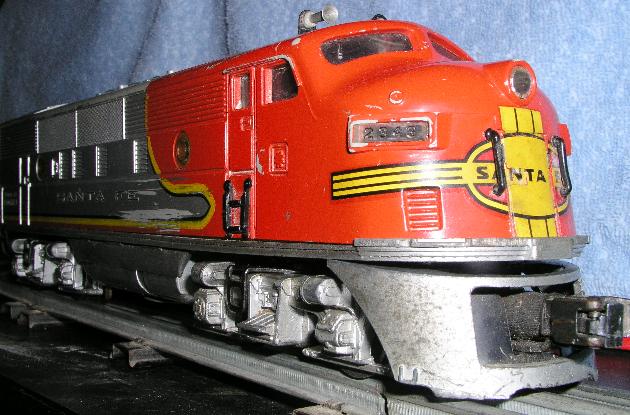 >
>No. 2343P Santa Fe Locomotive
Shown above is a Lionel Santa Fe diesel locomotive. The locomotive is a #2343P (powered) "A" unit and is part of an F3 freight outfit. This locomotive has dual electric motors, magnetic wheels to improve traction (Lionel called it "Magnetraction"), and a horn that runs on a 1.5V D-cell battery.
This locomotive and the train outfit described below is over 50 years old. This train was given to me as a Christmas present around 1959. Prior to my ownership, this train set belonged to my cousin.
Below is a picture of me on Christmas Day playing with this train.
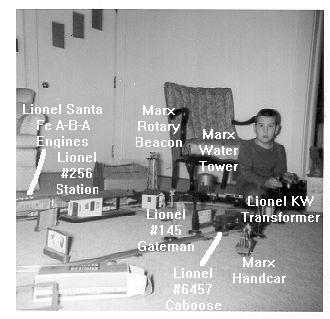
The photograph has been annotated to identify some of the train items in the picture. These items are described below. I had an elaborate setup on three 4 x 8 ft tables with two villages at either end and mountains and tunnels for the train to pass over and through.
The picture below shows the locomotive on a short track ready to go.
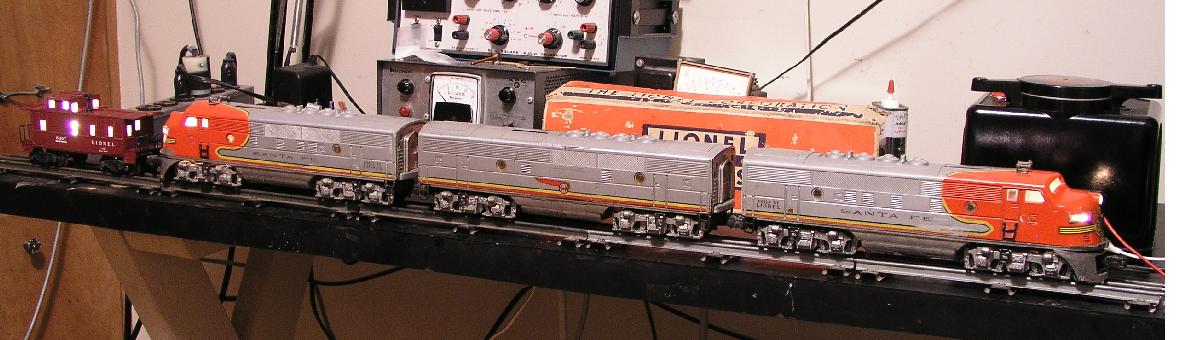
The powered Santa Fe locomotive has an associated "dummy" Santa Fe "A" unit locomotive (#2343T) that externally looks identical to the powered locomotive (both manufactured in 1950-1952). This combination is known as an "AA" unit. Between the two locomotives, there is an unmanned "dummy" engine #2343C "B" unit (manufactured in 1950-1955). A actual train would be configured this way if it were pulling a long line of freight cars. Also shown in the picture above is a caboose. Note that the two locomotives and the caboose are illuminated.
In the picture above, you can see the original box in which the #2343T "dummy" locomotive came in. I also have the original box for the #2343C "B" unit locomotive. Also shown is one two transformers I have to power the train set.
This train set is an "O" gauge train set. The train set has 3 rails. The two outer rails are electrically connected through the ties. The center rail is electrically isolated from the other two rails. The electrical connection to the rails is made through the train wheels and a set of rollers that roll on the center rail. The train is powered by alternating current with a maximum rms voltage of about 20 volts.
I have cleaned and oiled up the powered locomotive and it now runs well both forward and reverse. The original horn inside the locomotive was defective and I designed a solid-state replacement that uses a 9-volt battery instead of a 1.5-volt battery. The 9-volt battery easily fits inside the 1.5-volt compartment accessed on the underside of the locomotive.
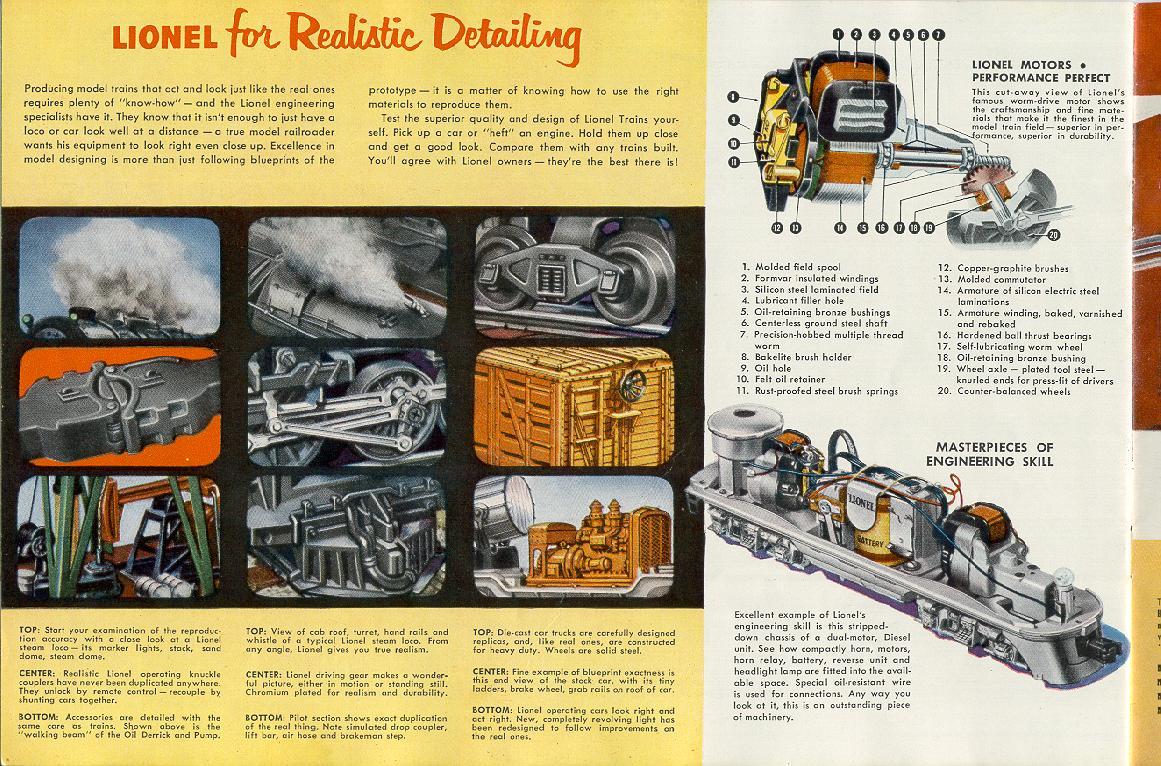
The locomotive is well designed and the detail and effort in developing this locomotive is described on page 26 of the 1952 Lionel catalog. This page is shown below.
Lionel #2191W Outfit (1952)
I believe the three Santa Fe engines I have were purchased as part of a Lionel Outfit #2191W that was released in 1952. This outfit is described on pages 18 and 19 in the 1952 Lionel Consumer Catalog, shown below.
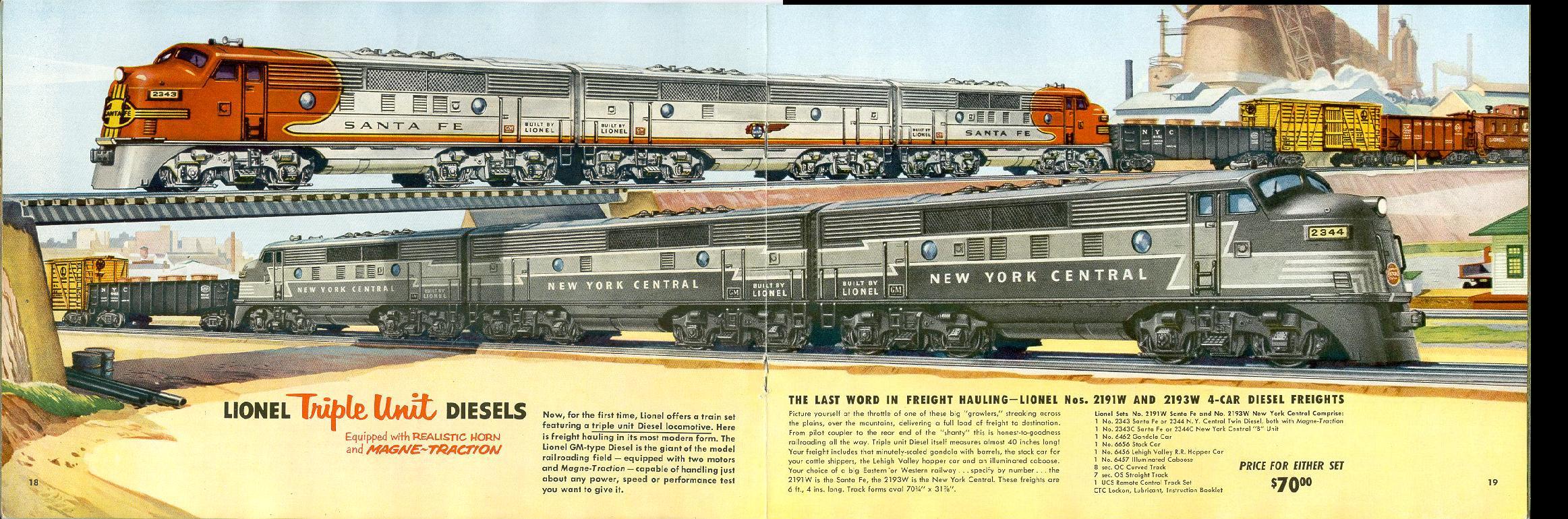
The #2191W Outfit was a 4-car diesel freight set that included the following components, all of which I have:
2343 A-A Santa Fe diesels (2343P and 2343T)
2343C B Unit (2343C)
6462 New York Central gondola car
6656 stock car
6456 Lehigh Valley hopper car
6457 SP-style caboose
The 1952 list price for the #2191W Santa Fe outfit was $70.
Below is a pictue of my Lionel No. 2191W outfit.

When the #2191W outfit was originally purchased, I believe the folowing additional Lionel items were also purchased:
#3461 Automatic Lumber Car
#3469 Automatic Dumping Ore Car
#3520 Operating Searchlight Car
#3472 Milk Car with Milk Platform
#145 Gateman
#256 Freight Station
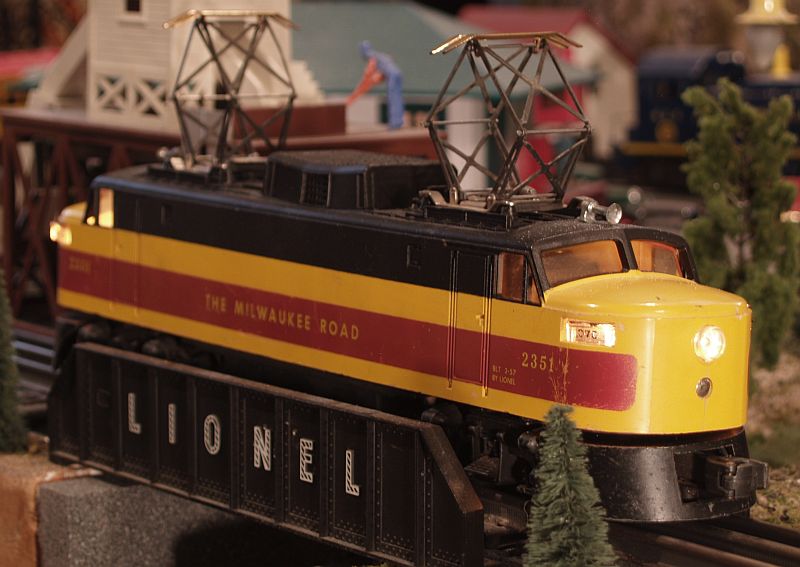
The Milwaukee Road EP-5
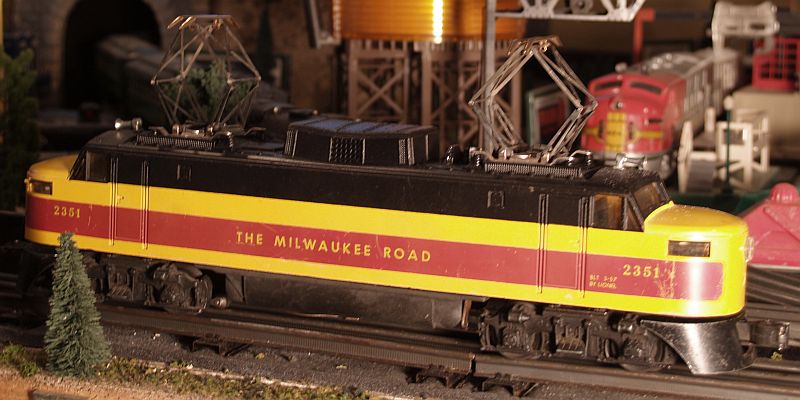
The picture above shows a Lionel No. 2351 The Milwaukee Road EP-5 electric locomotive (manufactured 1957 - 1958). The Milwaukee Road never operated a real EP-5 but they did have a similar locomotive but their paint scheme did not resemble this Lionel locomotive. This unit is identical to Lonel's 2350 New Haven with a single motor, 3-position E-Unit, and an operating horn inside. I had a locomotive identical to this one as a child. It came with the culvert loader, the Timken boxcar, and the van car.
Southern F3 Diesel ABA (1954 - 1956)
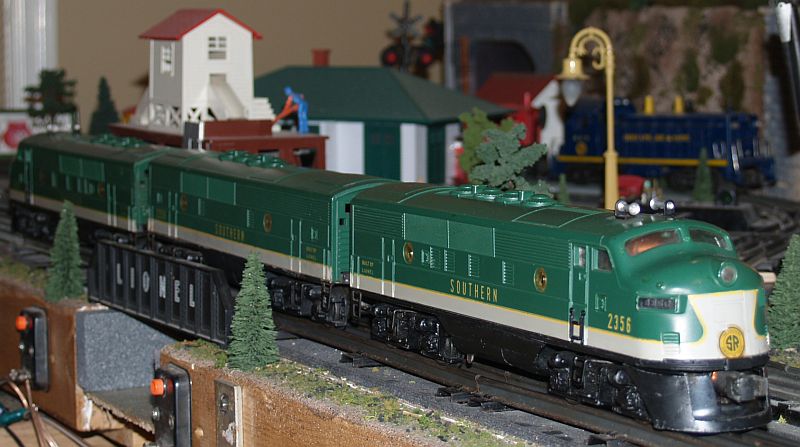
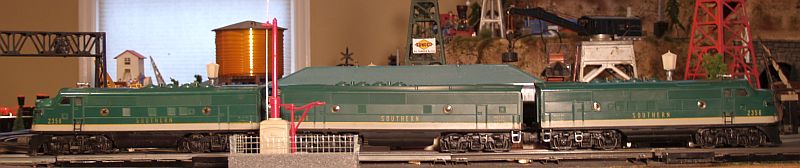
The picture above is a Lionel 2356 Southern F3 ABA Unit. The units have bodies painted green. The lower side panels and nose of the "A" units are painted gray with a rubber-stanped yellow sripe dividing the green from the gray. The bodies have louver-type roof vents and a two-piece ornamental horn. The frames, truck side frames, and the pilot are painted black. The "Southern" logo is a decal on the front of the A units.
The powered unit has twin horizontal motors and "Magnetraction" trucks. The direction is controlled by a lever-down three position E-unit. The operational horn is mounted in the dummy unit, unlike my 2353 Sante Fe F3 ABA set where the horn is mounted in the powered unit.
The A-unit bodies are mounted to the frame with only one flat-head screw in the front and two clips in the rear snap over the frame. An operating coupler is mounted in the front pilot and a non-operating coupler is mounted in the rear, similar to the 2343 Santa Fe.
When I received the set, the train would barely run and the horn did not work. A little WD40 on the axles loosened it up and it runs fine now. I had to adjust the screw on the bottom of the horn to make it work. The horn relay often needs adjusting as the horn will sound from vibration as the train travels down the track.
2329 Virginian EL-C or GE-33 Rectifier Locomotive (1958-1959)
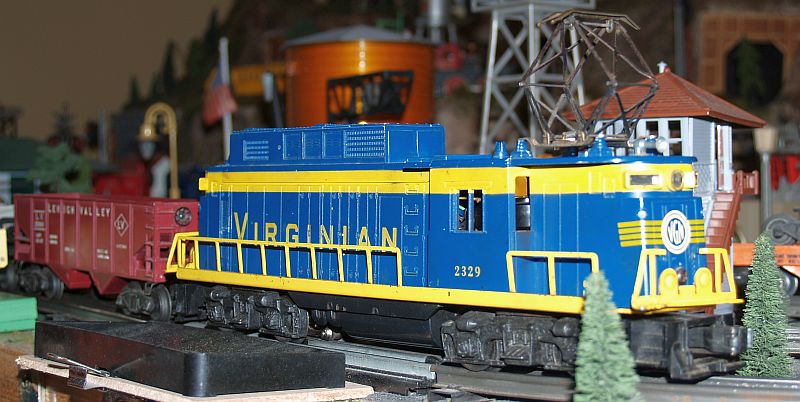
The picture above is a Lionel No. 2329 Virginian GE-C or GE-33 Rectifier locomotive manufactured between 1958 - 1959. The Lionel version of the locomotive has 4-wheel trucks based on the GP7 chassis (seen below for the Lionel No. 2339) but the actual locomotive has 6-wheel trucks and is larger in comparison to contemporary diesel switchers. The body of this locomotive is blue-painted plastic with a yellow stripe painted on the upper part. A Virginian "VGN" decal is on one end of the locomotive and the word "Virginian" heat-stamped on its sides. The body is mouned on a stamped metal GP7 locomotive frame painted yellow. There is a pantograph on the roof of the cab. The unit has Magnetraction, and operating horn and headlights on both ends. The unit has a single motor, a 3-position E-unit,and operating magnetic couplers.
The Virginian EL-C, later known as the New Haven EF-4 and E33, was an electric locomotive built for the Virginian Railway by General Electric in August 1955. They were the first successful production locomotives to use Ignitron (mercury arc) rectifier technology. Although they proved to be a successful design, no more EL-Cs were built, due to the small number of railroads that had electrification and the advent of improved electric locomotive technology. They were among the last mainline electric freight locomotives in the United States.
In the mid-1920s the Virginian Railway had adopted an 11 kV 25 Hz AC electrification for its coal-heavy main line between Mullens, West Virginia and Roanoke, Virginia. GE delivered 12 locomotives, numbered 130–141, to the Virginian between October 1956 and January 1957. The locomotives performed well in freight service and the Virginian retired the EL-3As as planned. The situation changed dramatically in December 1959 when the long-discussed merger between the Virginian and the Norfolk and Western Railway occurred.
The rectifiers converted the overhead AC to DC. A transformer stepped the voltage down from 11 kV to feed the rectifier. The DC voltage from the rectifier was then smoothed by a reactor before it was passed on to the traction motors. There were six traction motors, one for each axle. Starting tractive effort was 98,500 lbf (438,000 N); maximum power output 3,300 hp (2,500 kW). The maximum speed of the locomotive was 65 mph (105 km/h). Each locomotive had six axles in a C-C configuration. They were 69 ft 6 in (21.2 m) long and weighed 174 short tons (158 t).
2339 Wabash GP7 Locomotive (1957)
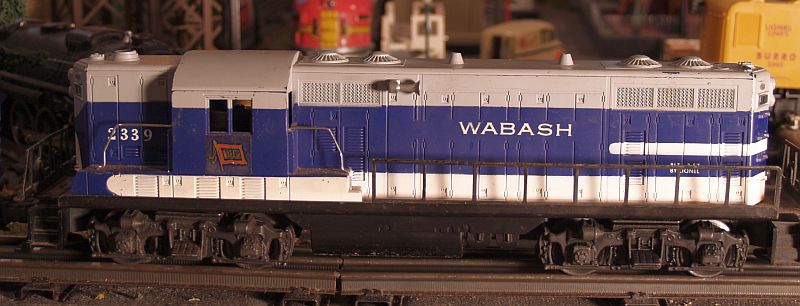
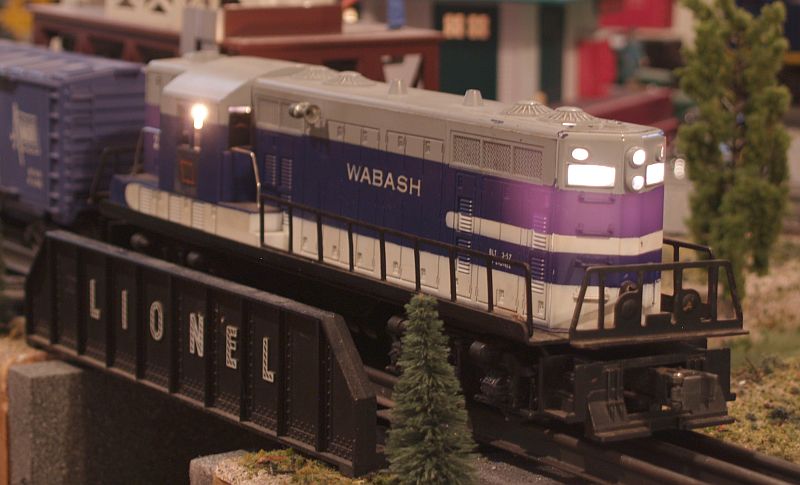
The picture above is a Lionel No. 2339 Wabash GP7 road switcher manufactured in 1957. This unit is identical to the Lionel 2337 but this unit was upgraded to include operating couplers. This attractive unit has an unpainted blue body with its upper surfaces painted gray with white striping. The Wabash flag logo is a decal placed below the window on both sides. The unit has an operating headlight on each end and an operating horn inside. The horn is the typical battery-powered bicycle horn. The unit has a single motor and a lever-down E-unit.
Below are pictures of the freight cars that I have.
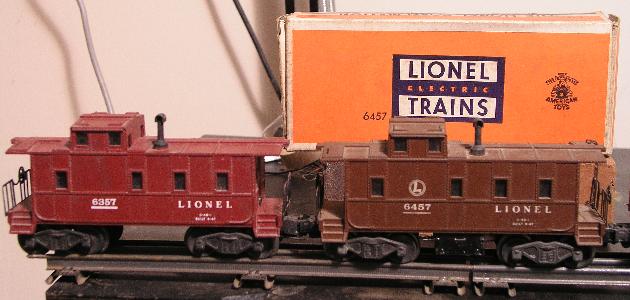
The picture above shows two cabooses I had from long ago. The one on the left is a #6357 (1948-1961). The one on the right is a #6457 (1949-1952) for which I have the original box.
The 6357 caboose is fairly common and due to its long 14-year production run, it has undergone numerous variations.
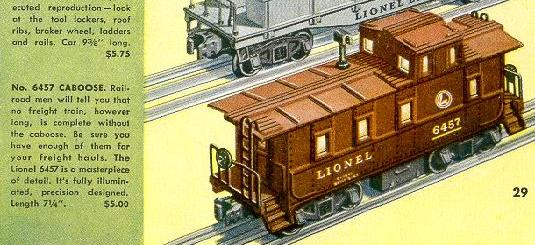
The #6457 caboose was Lionel's premium SP-style caboose and is fairly easy to obtain. This caboose was included with Lionel's better train sets and included with my #2191W Outfit.
You could purchase the #6457 caboose separately in 1952 for $5 as shown on page 29 of the 1952 catalog. See below:
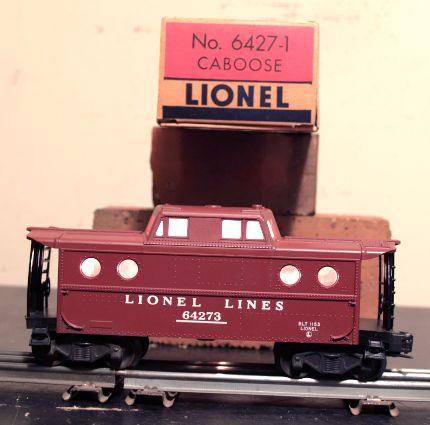
I have a Lionel No. 6427-1 Lionel Lines N5c porthole caboose (manufactured from 1954-1960. This caboose is Tuscan painted with white heat-stamped lettering including the number "64273." As you can see, the caboose is illuminated and has bar-end trucks and one coupler. Note that I have the original box for this caboose.
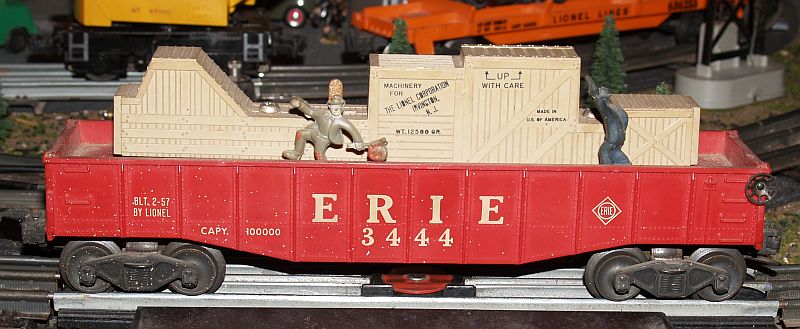
The picture above shows a Lionel No. 3444 Erie Hobo and Cop car (manufactured from 1957-1959). The car has a vibrator mechanism inside that drives a belt with a hobo and cop figure attached. When the control level is moved to the on position and power is applied to the track, the vibrator mechanism activates and the cop appears to be chasing the hobo around the crates in the center of the car. The car has bar-end trucks with tab couplers.
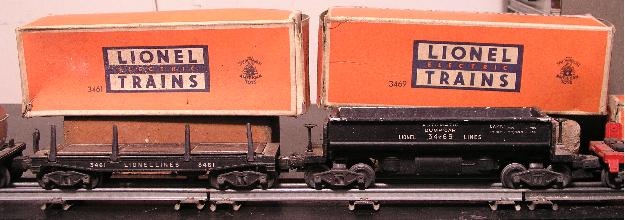
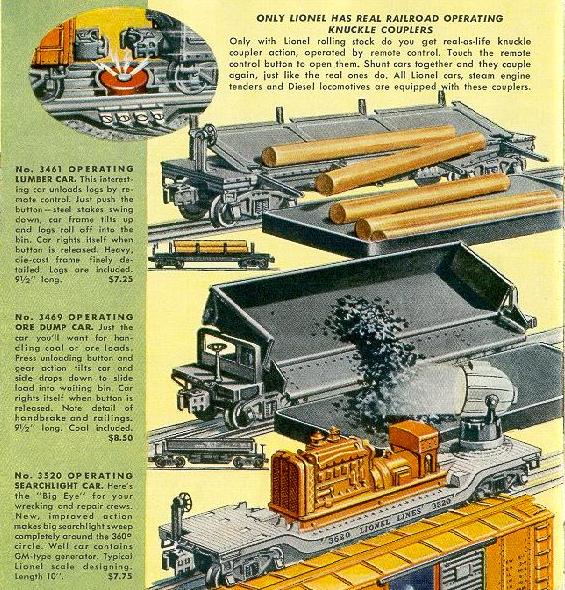
The picture above shows 2 automatic dumping cars I have. As shown, I have the original boxes for both of these cars. The car on the left is a #3461 automatic lumber car (manufactured between 1949-55) and the one on the right is a #3469 automatic dumping ore car (manufactured between 1949-55). I have 3 logs for the log car and a Lionel #207 bag of artificial coal for the ore car. I have one Model #160 plastic bin that sits by the track to catch the contents of the cars. The cars can dump their contents only when they are on the #UCS remote-controlled (by wire) decoupling and unloading track section.
These cars were listed on page 28 of the 1952 catalog as shown below. Shown on the top left is the #UCS remote control track section. Also shown on this catalog page is the #3520 Operating Searchlight Car I have.
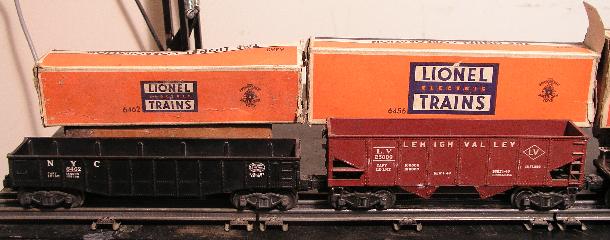
The picture above shows a #6462 New York Central gondola car and a #6456 hopper car with the original boxes. I have wood barrels that go in the gondola car which was included with my 2191W Outfit.
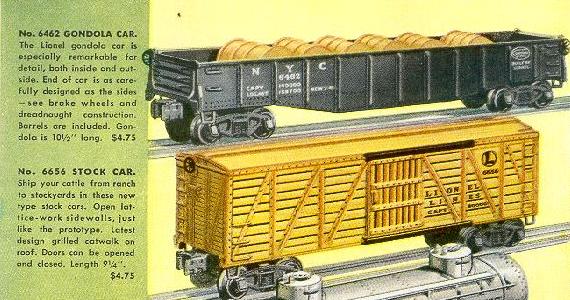
The #6456 Lehigh Valley hopper car was also included with my 2191W Outfit. The #6462 NYC Gondola Car as listed on page 29 of the 1952 catalog along with the #6656 Stock Car I have as shown below.
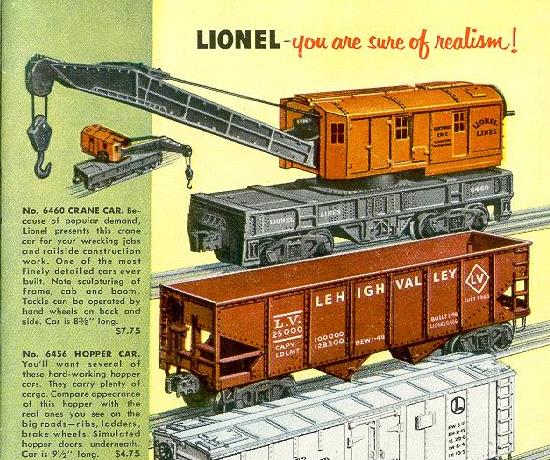
The #6456 Lehigh Valley Hopper Car was also listed on page 29 of the 1952 catalog as shown below.
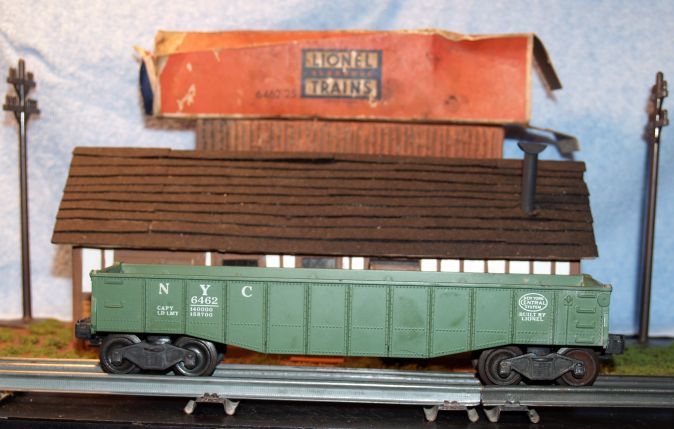
I also have a green gondola car (shown above). It is a Lionel No. 6462-25 (manufacturered 1954-1957) although the -25 number shows nowhere on the car. The "N" of the NYC logo is stamped in the second panel from the left on my car indicating the car was manufactured early in the production run. I have the original box for this car, although the box is quite worn. The car is is reasonably good shape with only one or two wheels a bit rusty.
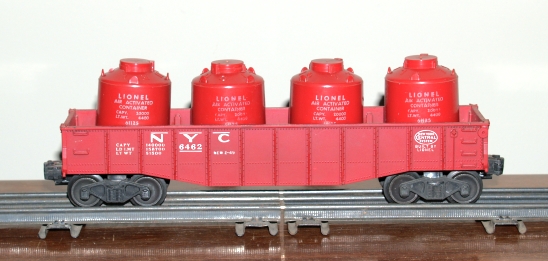
I also have a red gondola car (shown above). It is a Lionel No. 6462 (manufactured 1954-1957). The car is painted red and the "N" of the NYC logo is stamped in the third panel from the left on my car. The car is also stamped "NWE 2-49". These things indicate that this car was one of the later ones produced. I received this car with the load of four red cansiters stamped with "Lionel Air Activated Container" on them. It is my understanding that this load is normally associated with the Lionel 6562 gondola. However, when I received this car, there was a significant amount of dust on the canisters and car and when I removed the cansiters, there was no dust under them. All this indicates to me that the canisters have been associated with my 6462 red gondola for a long time. Furhermore, the Lionel repair manual does associated the 6462 red gondola with a canister load like I have. So I believe these canisters came with this car.
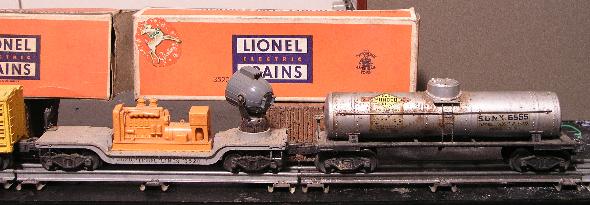
The picture above shows a #3520 operating search light car (1952-1953) with its original box and a rusty #6555 tank car (1949). The searchlight lights up and rotates. Note the SUNOCO name on the tank car.
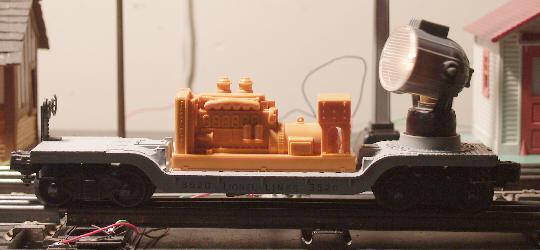
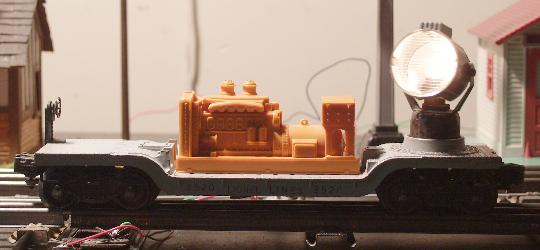
The searchlight car is typically a reliable car and is still in demand by collectors and operators. On my searchlight car, the metal bracket holding the plastic searchlight lens is chemically blackened and has 8 holes. I understand this version is rare. The searchlight has a vibrating motor that makes the lens rotate. Below are two pictures of the searchlight car in operation.
 |
 |
As noted above, the #3520 Operating Searchlight Car was listed on page 28 of the 1952 catalog.
The #6555 tank car was the last of the pre-WWII style tank car produced by Lionel. The all-metal construction of this car is still remains a favorite of collectors and operators. After 1950, the tank cars manufactured by Lionel are made of plastic. The tank car has the words "gas" and "oil" above and below the SUNOCO name indicating the car was manufactured in 1949.
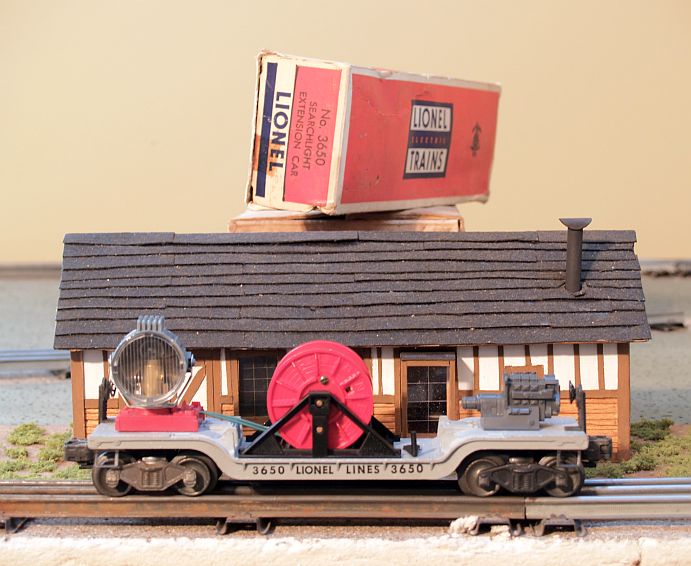
The picture above shows a Lionel #3650 Searchlight Extension Car (manufactured from 1956 - 1959). This car is a metal car with a depressed center frame with a molded generator placed on one of the step decks of the car. On the other step deck, the searchlight is mounted on a red base with a magnet unnderneath to secure it to the deck. A red cable reel stucture is mounted on the depressed area onto which a 2-conductor green cable is wound. This cable applies power to the searchlight as picked up from the track. A die cast reel handle used to wind the cable on the reel is placed next to the reel. The searchlight can be removed from the car and positioned anywhere where the cable will allow. The searchlight itself is quite similar to the one on the #3520 car I have. The # 3650 searchlight does not rotate. My #3650 searchlight car is painted light gray - another variant is painted dark gray. Note I have the origianl box for this car.
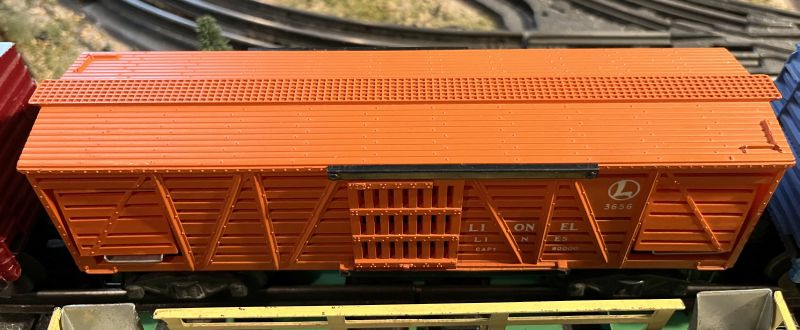
The picture above shows a Lionel #3656 Lionel Lines Operating Cattle Car (maufactured from 1949 - 1955). The car body is painted orange and the lettering heat-stamped. The door on the side shown is fixed and does not open, whereas the door on the opposite side functions as a control to stop or allow the movement of cattle within the car. Doors on either side of the side shown open to allow the cattle to pass to and from the corral. This example car was manufactured after 1951 as it has bar-ed trucks.
The car and Lionel #3656-150 Stockyard (corral) are shown below along with the original box contaning the cattle (Lionel 3656-44) and the control switch (Lionel 364C).
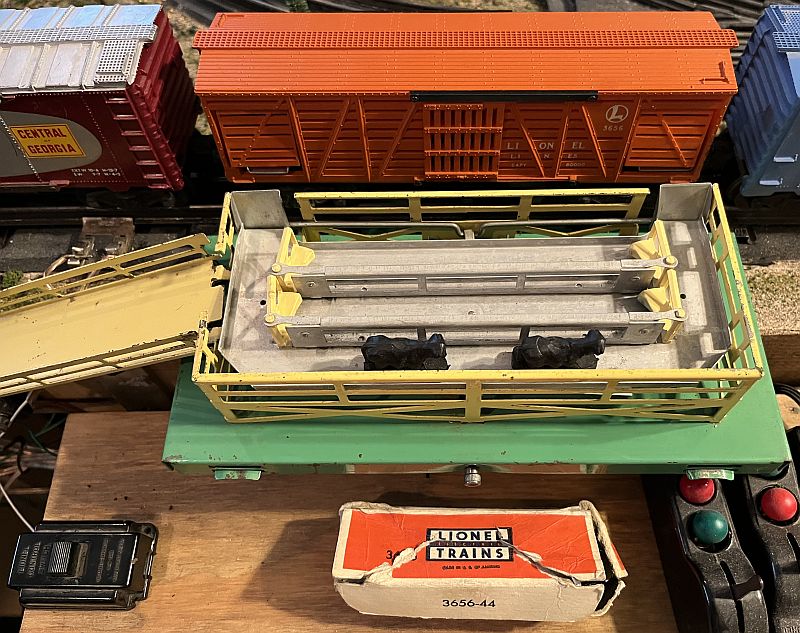
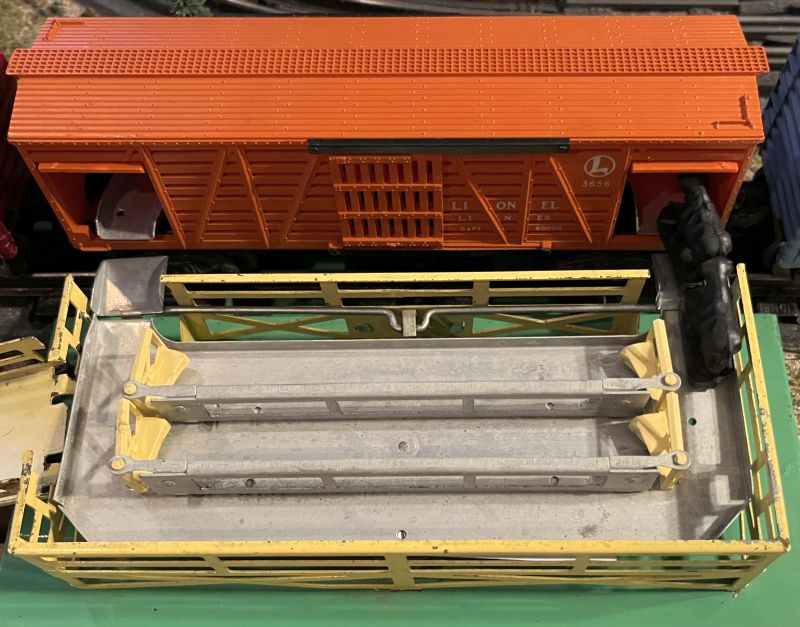
The car and corral operate using Lionel's vibrator mechanism. An electrical solenoid in the car lifts the two doors and vibrates a metal semi-circular chute that runs inside the car from one door to the other. Another solenoid under the corral platform lowers the corral gates and vibrates the entire coral to move the cattle from left to right. To vibrate, the car receives its control power through a "flying shoe" on each of the car trucks. One "flying shoe" is connected to the outside rail and the other one is connected to the corral platform. The corral platform receives its power from the track center rail and outer rails.
Below is a picture of the corral and car operating to load cattle onto the car.
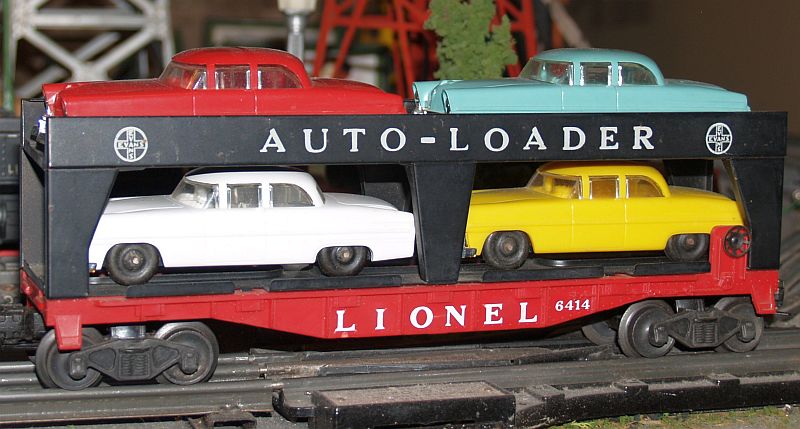
The picture above shows a Lionel No. 6414 Evans Auto Loader car, manufactured from 1955 to 1966. The body of the car is plastic and has a painted black steel superstructure. There are four 5/16-inch long plastic automobiles contained within the superstructure. This car has bar-end trucks and magnetic couplers. The colors of the automobiles are red, green, white, and yellow. Each car has chrome-plated bumpers and clear plastic windows. The black superstructure is rubber-stamped with "AUTO-LOADER" in the center and the circular Evans Products logo on both ends of the superstructure. The decks of the superstructure have non-skid patterns embossed in them. This example was produced from 1955 to 1957.
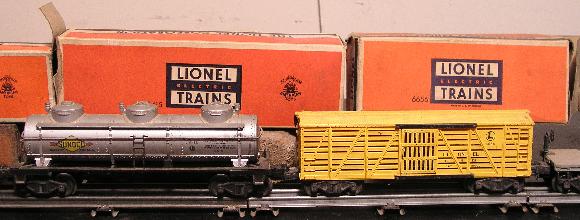
The picture above shows a #6415 tank car (1953-1955) and a #6656 stock car (1950-1953) with their original boxes. Note the old SUNOCO name on the tank car.
The tank car is one of only two-triple dome tank cars produced by Lionel after WWII. This car is not particularly rare. Note that this car has the three filler caps in tact. The caps are fragile and often broken.
The #6656 stock car was introduced in 1950 and was manufactured for 4 years. It is good representation of actual stock cars of the 1950's and was included with my 2191W Outfit. As noted above, the #6656 Stock Car was listed on page 29 of the 1952 catalog.
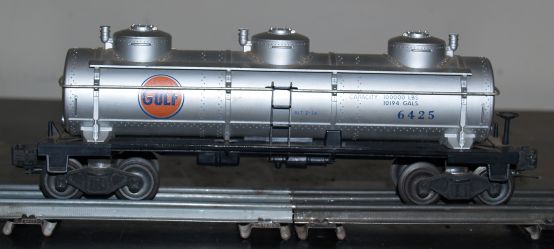
I also have a Lionel #6425 3-dome Gulf tank car (manufactured 1956-1958). This car is essentially identical to my 3-dome #6415 Sunoco tank car shown above with the primary difference being the Gulf logo instead of the Sunoco logo.
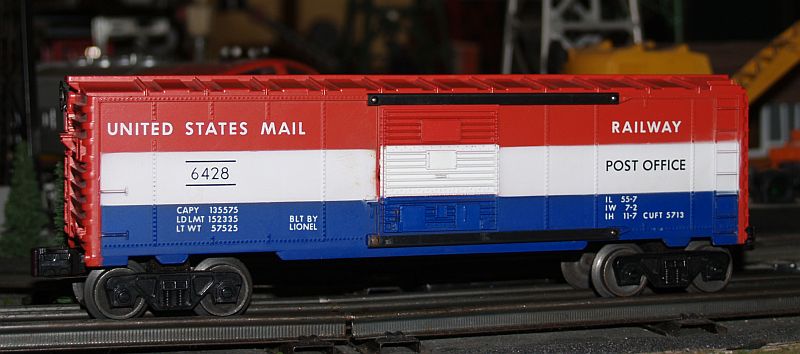
The picture above shows a Lionel red, white, and blue United States Mail Car (manufactured 1960-1961 and 1965 -1966). The car has Railway Post Office marknigs.The car has AAR-type trucks with operating couplers.
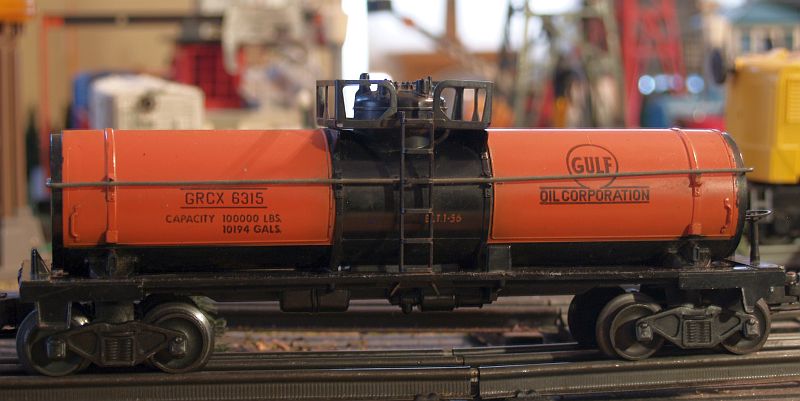
I also have a Lionel #6315 single dome Gulf chemical tank car (manufactured 1956-1958). This car has black ends and a central band painted black. The remainder of the tank is orange.
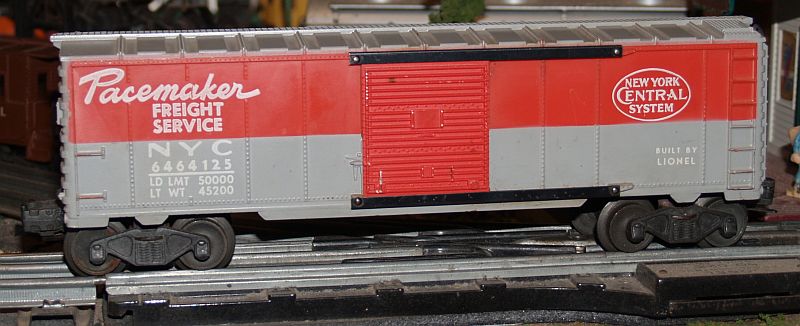
The picture above shows a Lionel No. 6464-125 Pacemaker boxcar (manufactured from 1954-1956). The boxcar is molded in red plastic. The red areas are left unpainted and the gray areas are painted gray. Rubber-stamped white lettering is used. The car has a blackend metal brake wheel, blued steel door guides, and bar-end trucks with magnetic tab couplers.
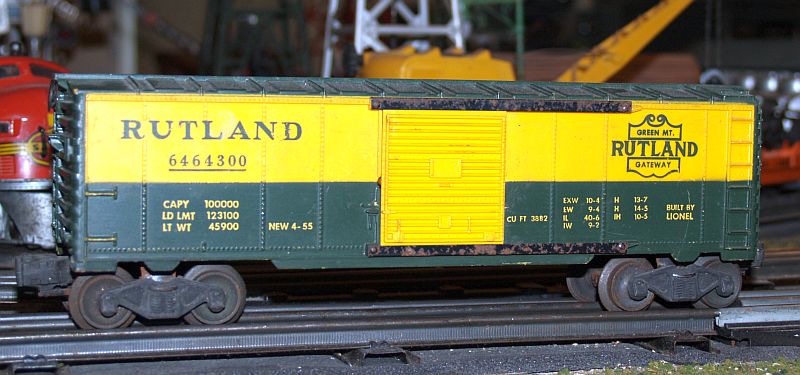
The picture above shows a Lionel No. 6464-300 Rutland boxcar (manufactured from 1955-1956). The boxcar has a yellow body and dark green roof, lower sides,and ends. This car has bar-end trucks with magnetic couplers.
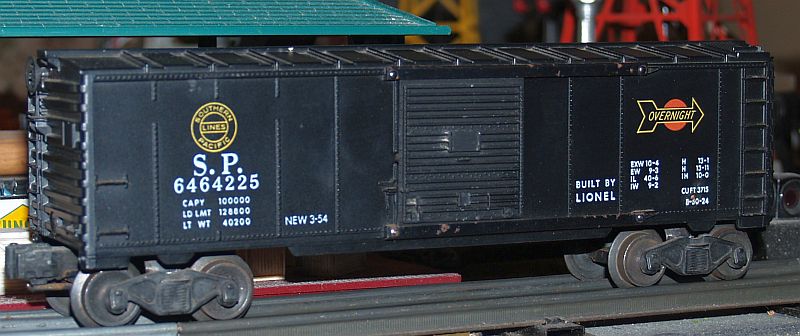
The picture above shows a Lionel No. 6464-225 Southern Pacific Boxcar produced from 1954-1956. The body and single tack board doors are painted black with white and yellow lettering. This car has bar-end trucks with tab magnetic couplers.
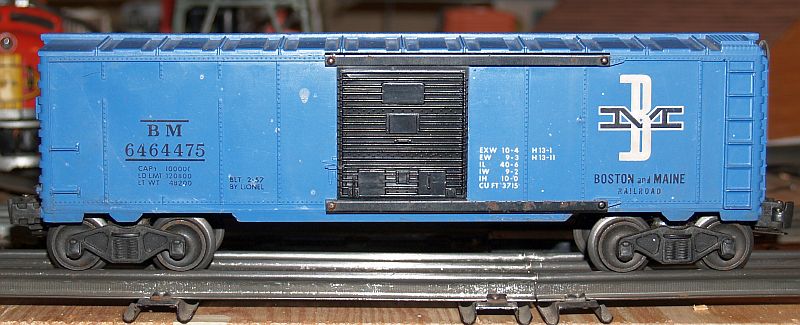
The picture above shows a Lionel No. 6464-475 Boston and Maine boxcar (manufactured from 1957-1960). The boxcar has a blue body with an unpainted black door. This car has bar-end trucks with tab magnetic couplers.
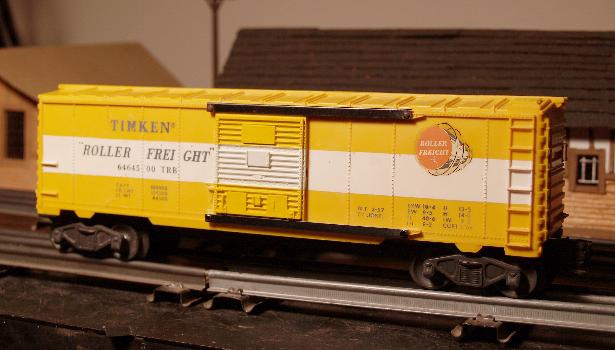
The picture above shows a #6464-500 Timken boxcar (manufactured from 1957-1959). The boxcar had a missing door on the side shown when I received it long ago. I purchased a replacement door along with the lower door guide and painted the door to match the original colors. You can see the result in the photo. The yellow was the most difficult to match and I found that Model Master "Insignia Yellow" (#FS33538) paint for plastic models was the perfect match.
The good graphics with bright yellow exterior and realistic markings on the Timken boxcar make this sought after by collectors and operators. This boxcar is apparently somewhat rare. As with mine, the yellow and white colors are prone to attracting dirt and smudges but the graphics on mine are still reasonably sharp.
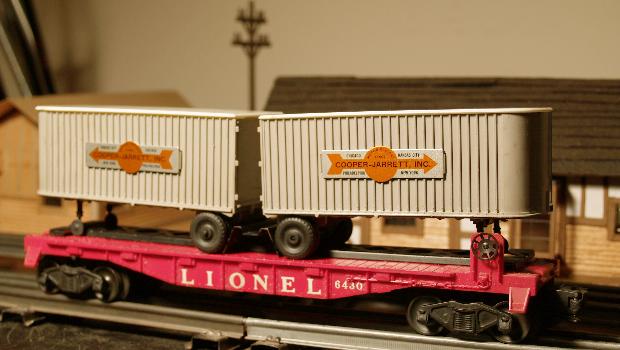
The picture above shows a #6430 Cooper-Jarrett van car (manufactured from 1956-1958). When I received the car years ago, the two vans were missing. I was able to obtain the two vans; however, the tops of the vans are replacements and are white rather than gray that is the color of the sides of the vans. The Cooper-Jarrett logos on the sides of the vans are stainless steel with a copper-colored arrow and black lettering. The arrow always points forward so the logo plates are not interchangeable from side to side. The vans have dual wheels on the rear and single wheels on the front. I understand Lionel made several dual-van flat cars, but the Cooper Jarrett ones are the most desirable.
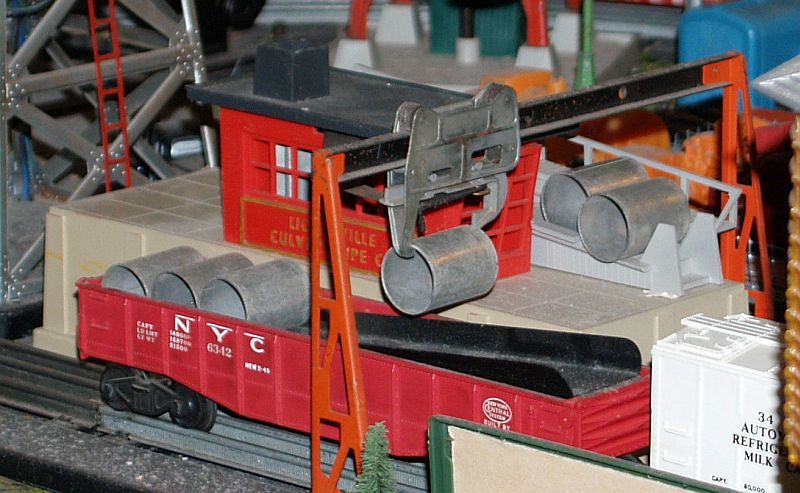
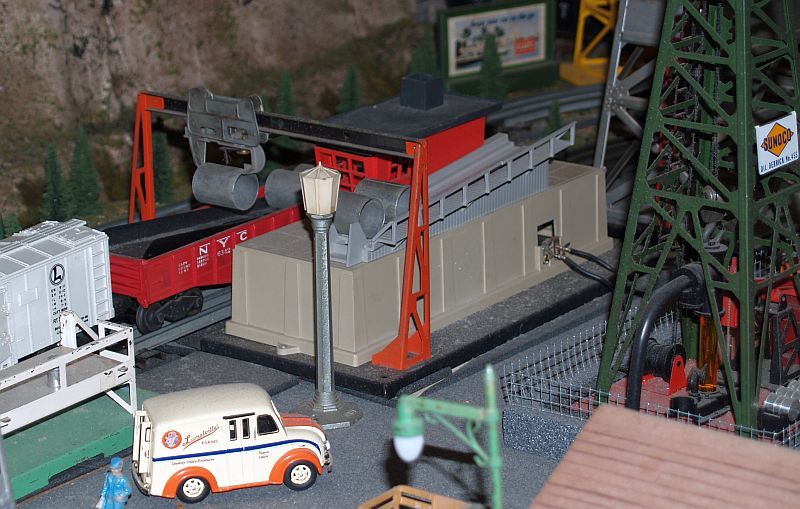
The picture above shows a 6342 culvert hauling car with the attendant model 342 culvert loader (manufactured from 1957-1959) containing the sign "Lionelville Culvert Pipe Company." The loader has an overhead crane that transfers the culverts from the "building" to the car. You can see one culvert being held by the crane. The crane is powered by an electric vibrator motor and can be controlled remotely. The culverts are metal. Below is another picture of the culvert loader.
The culvert loader was featured in a Twilight Zone episode entitled "Night of the Meek" that featued actor Art Carney as Henry Corwin, a down-and-out drunk that was hired to play Santa Claus in a department store. He was subsequently fired by Mr. Dundee, the manager, acting on complaints from customers about his drunkenness. He stumbles into an alley where he hears sleigh bells and trips over a large burlap bag, filled with packages, that seems to have the ability to produce any item that's asked of it. At the end of the show, he returns to the alley where the gift-laden garbage bag had presented itself, and there he encounters an elf sitting in a large sleigh hitched to four reindeer waiting for him. The episode first aired on December 23, 1960 and was the 47th episode overall. Below is a screenshot from early on in the episode showing the Lionel 342 culvert loader loading a metal culvert onto a car.
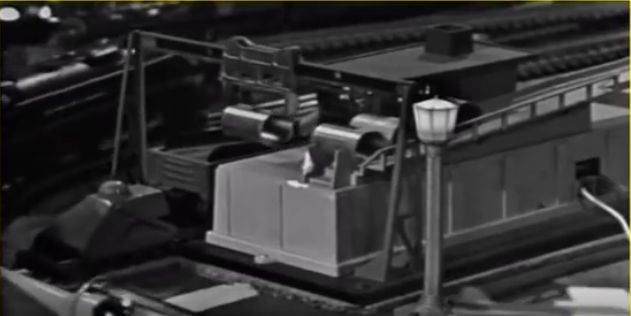
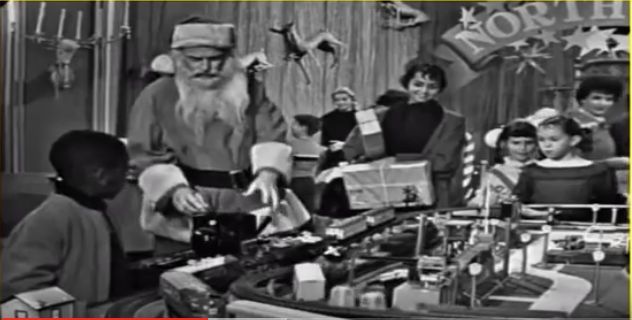
Note there is a Lionel No. 71 lamp post nearby the loader. A Lionel No. 260 bumper can also be seen next to the loader at the end of the track where the culvert is being loaded onto the car. Below is another screen shot showing a wider view of the train layout and "Santa" at the control transformer (a Lionel Model ZW transformer).You also can see a Lionel No. 145 gateman house in the lower left corner of the picture next to the young boy. Note there are several No. 71 lamp posts on the layout. You can also see a Sante Fe diesel engine on the layout on the lower left of the picture.
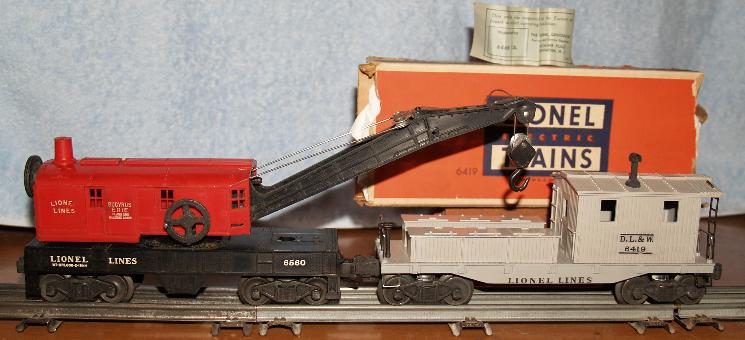
The picture above shows a #6560 "Bucyrus Erie" crane railroad car (manufactured from 1955-1969) and a #6419 D. L&W wrecking car caboose (manufactured from 1948-1950 and 1952-1955).
On the #6560 crane car, the crane arm moves up and down by a handwheel on the rear of the crane cabin. The crane hook also moves up and down by a handwheel on the side of the crane cabin. My car has a molded plastic frame, molded red cab, an open-spoked hand crank on the side shown (the crank on the rear does not have open spokes), and bar-end trucks suggesting it is an early version of the car.
The #6419 Wrecking car is in like-new shape and note that I have the original box with its liner to support the car although the box is not in good shape. I even have the Lionel inspection slip shown sitting on the top of the box. The initials on the car stand for Delaware, Lackawanna, and Western railroad. The car has a metal die cast frame, two molded plastic tool boxes, and a molded plastic cab, all painted light gray. A tall black die cast smokestack is mounted on the cab and a brake wheel and vertical post assembly on each end. Wire handrails are included on both ends, also. My car has bar end trucks with couplers on both ends indicating it is the later vintage and manufactured between 1952 and 1955.
These two railroad cars are often seen in tandem as shown in the picture when being pulled in a line of railroad cars. With the cab of the caboose being toward the rear of the car and the tool boxes in the front, that layout provides a natural space for the arm of the crane.
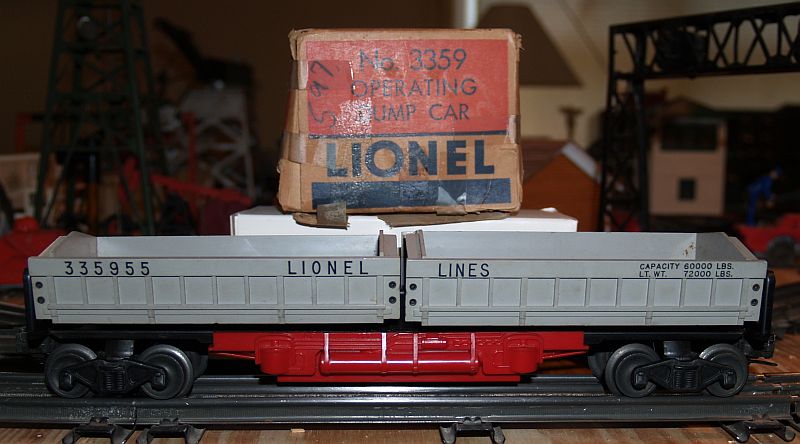
Lionel No. 3359 Twin Bin Operating Dump Car
The picture above shows a Lionel No. 3359 Twin Bin Operating Dump car (manufactured from 1955-1958). The two bins are made of unpainted gray plastic with black heat-stamped lettering. The bins tilt to dump the cargo in sequence. To operate (dump) the cargo, one pulses the "uncouple" control of a Lionel uncouple/unload track section and a cam device under the car steps through its sequence and tilts one bin in small increments and then tilts the other bin in a similar sequence. Note that I have the original box for this car and the price when purchased was $5.97.
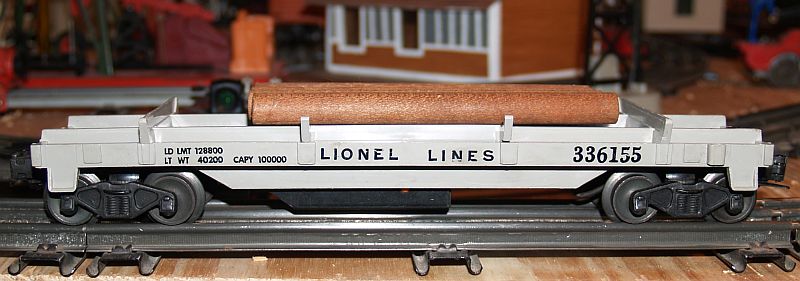
Lionel No. 3361 Operating Log Dump Car
The picture above shows a Lionel No. 3361 Operating Log Dump Car (manufactured from 1955-1959). The car has a separate molded plastic dump frame mounted on the center of the plastic body. The frame is raised incrementally by pulsing the "uncouple" control of a Lionel uncouple/unload track section. This action causes the stained wooden dowel logs to eventually roll off. My car is the later version as it has sans-serif lettering. I have four dowel logs that came with this car.
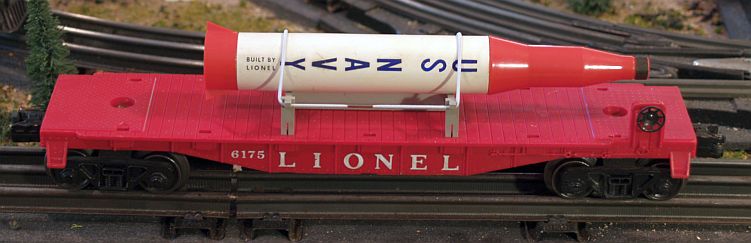
Lionel No. 6175 Rocket Car
The picture above shows a Lionel No. 6175 Rocket Car (manufactured 1958-1961). The rocket on the car is the rocket used by the No. 175 Rocket Launcher accessory. The rocket has a white plastic body with "Built by Lionel" and "US NAVY" heat-stamped on it. The rocket is secured to the No. 6801 boat rack with a 6418-9 elastic band. The car has AAR-type trucks.

No. 6461 Transformer Car
The picure above shows a #6461 Transformer Car (manufactured from 1949-1950). This is a nicely detailed depressed center flat car. The diecast metal frame is painted medium gray with rubber-stamped lettering in black. A simulated transformer load is mounted on the depressed center of the car. The transformer has a decal at the top on only one side that says "transformer car." The car has blued steel steps and blackened steel brakestands. The car has staple-end trucks with magnetic couplers. I believe my car has the original transformer white insulators - these are easily broken.
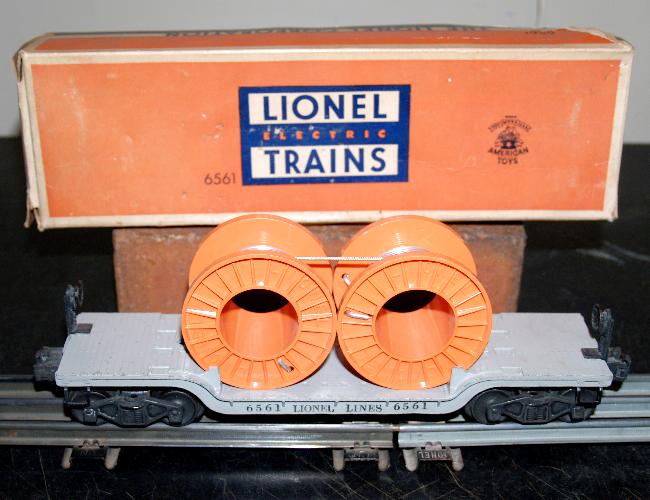
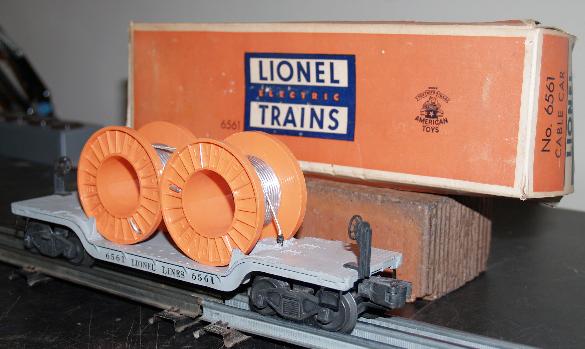
No. 6561 Cable Car
The picure above shows a #6561 Cable Car (manufactured from 1953-1956). This car has the original cable reels with the aluminum wire wound around the reel. It also has the elastic band that runs across the two reels and is attached to the flatcar in two places. This car features a gray painted metal depressed center flatcar with black lettering, bar-end trucks with operating couplers, metal footsteps at each corner, and a brakestand and brakewheel at each end. My car has the more common orange reels. Note that I also have the original box for this car.
No. 6561 Cable Car
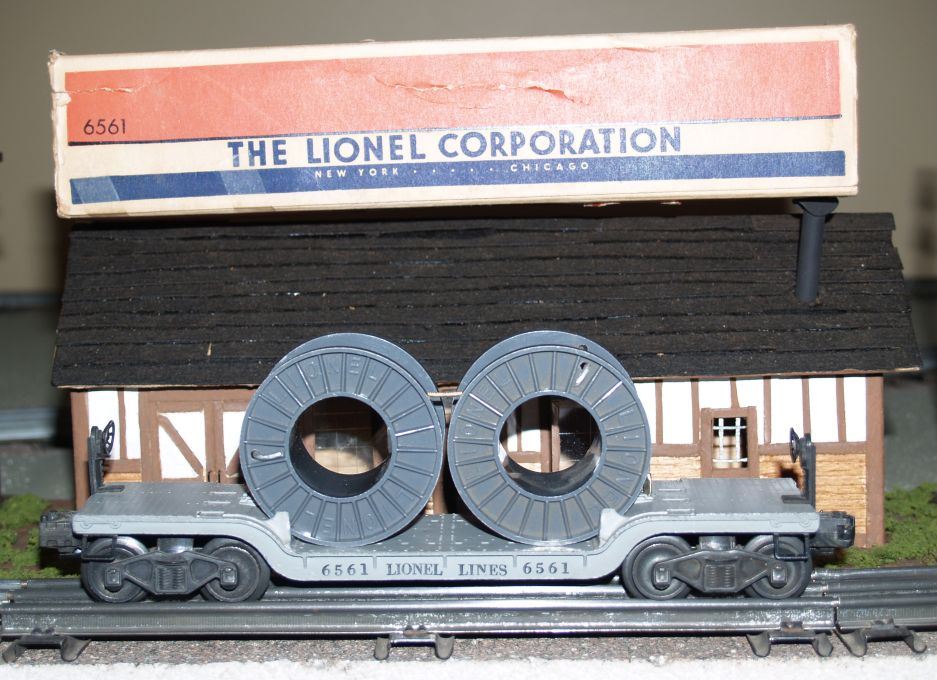
The picure above shows a #6561 Cable Car (manufactured from 1953-1956) but with the relatively rare gray reels. This car has the original cable reels with the aluminum wire wound around the reel. It also has the elastic band that runs across the two reels and is attached to the flatcar in two places. This car features a gray painted metal depressed center flatcar with black lettering, bar-end trucks with operating couplers, metal footsteps at each corner, and a brakestand and brakewheel at each end. Note that I also have the original box for this car.
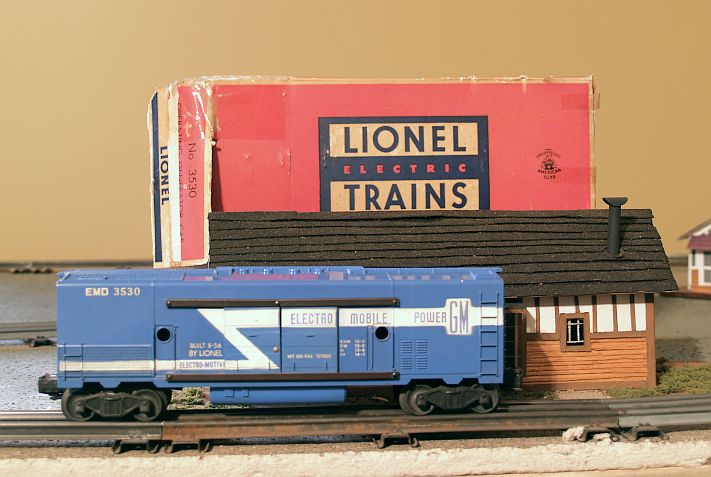
No. 3530 Operating Generator Car
The picture above shows a #3530 Operating Generator Car (manufactured from 1956-1958). The car is a replica of a General Motors Electro Motive Division generator car. It is made of blue plastic with a white stripe painted on its side. Mine has the stripe going through the ladder at the end - other versions have the stripe ending at the ladder. The car has double sliding doors on each side. The left-hand door on the side shown above has a contact switch that when opened, turns on an internal light and starts a vibrator motor driven simulated fan. Inside is also an orange generator that is the same as on the No. 3520 searchlight car I have. Note that I have the original box for this car.The picture below shows the doors open and the light on inside.
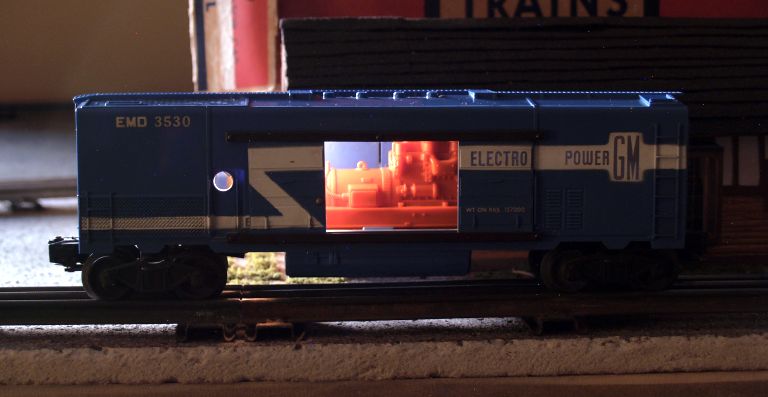 No. 3530 Operating Generator Car with Light On Inside
The top of the car has ventilation holes through which you can see the light and the simulated fan turning. The picture below shows the top of the car with the interior light shining through.
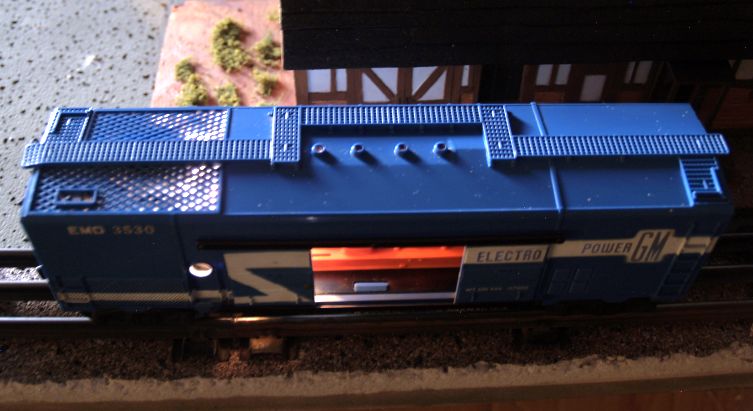 No. 3530 Operating Generator Car Top View with Light On Inside
My generator car has blue fuel tanks below the doors. Other versions have black fuel tanks. The car originally came with a telephone pole/transformer and a searchlight that can be connected to the top of the car and the searchlight illuminates when the door is opened. The telephone pole/transformer and searchlight could also be purchased separately as Lionel # 3530-30. The generator car with the telephone pole/transformer and searchlight connected are shown in the picture below.
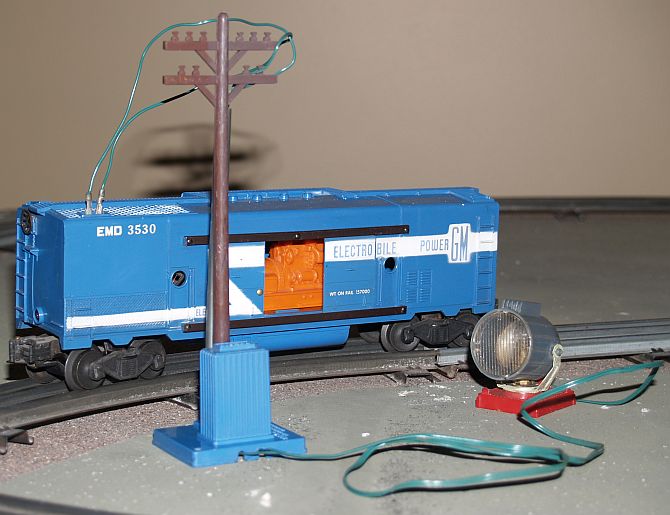
No. 3530 Operating Generator Car With Telephone Pole, Transformer and Searchlight
The picture below shows the setup with the searchlight illuminated as powered by the generator car.
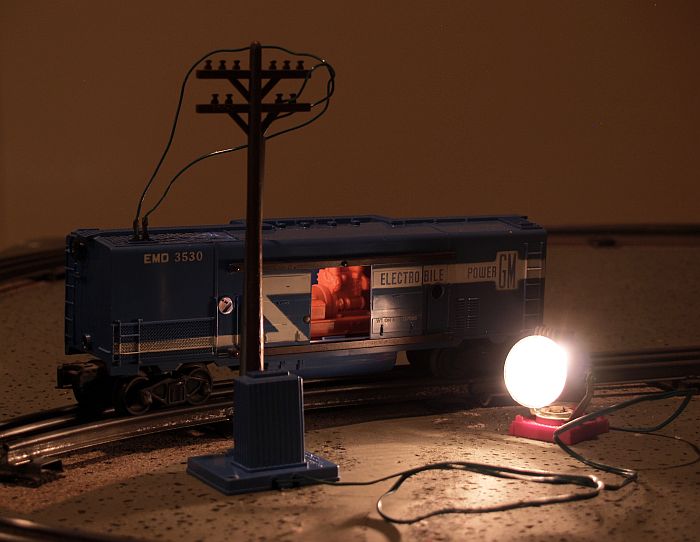
No. 3530 Operating Generator Car With Telephone Pole, Transformer and Searchlight Illuminated
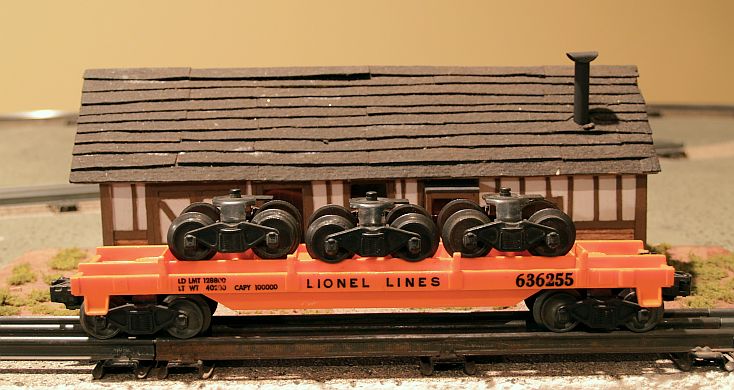
No. 6362 Railway Truck Car
The picture above shows a Lionel #6362 Railway Truck Car (manufactured 1955-1957). This car has an unpainted orange plastic body mounted on a blued steel chassis. The car has bar-end metal trucks and magnetic couplers. The cargo load for this car are three 479-1 bar end metal trucks.
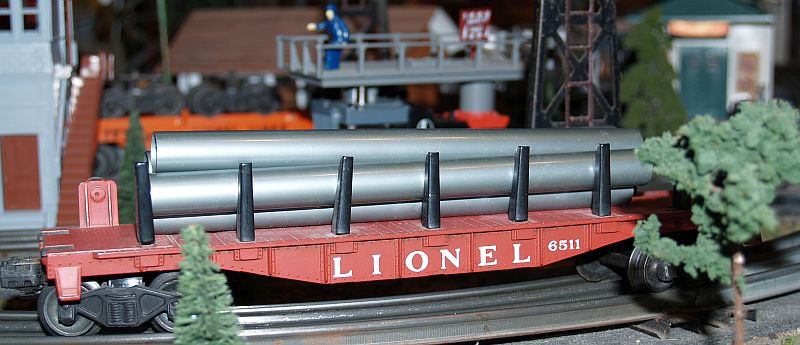
No. 6511 Pipe Car
The picture above shows a Lionel #6511 Pipe Car (manufactured 1953-1956). The car is red with heat-stamped "Lionel 6511" lettering on both sides. The car has bar-end metal trucks with magnetic couplers. Five silver-gray plasic pipes is the load carried by the car. Thirteen spring steel posts hold the pipes in place. This car has heavy die-cast plates on the underside of each end to which the trucks are attached. As such, this car was manufacgtured in 1953.
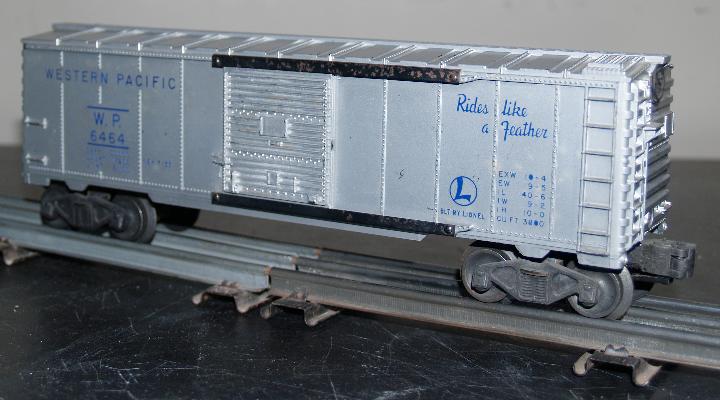
No. 6464-1 Western Pacific Box Car
The picture above shows a Lionel #6464-1 Western Pacific box car (manufactured from 1953-1954). This box car was the first car in the 6464 series of box cars. I understand the 6464-1 Western Pacific is a fairly common car. It was included in sets as well as being available for separate sale. The 6464-1 Western Pacific includes a silver painted shell with blue lettering, type I body style, single block sliding doors, bar-end trucks with two operating couplers, and a single brakewheel. The silver paint on this car tends to fade with age but the silver paint on mine is reasonably bright. The blue lettering on mine in in good shape also.
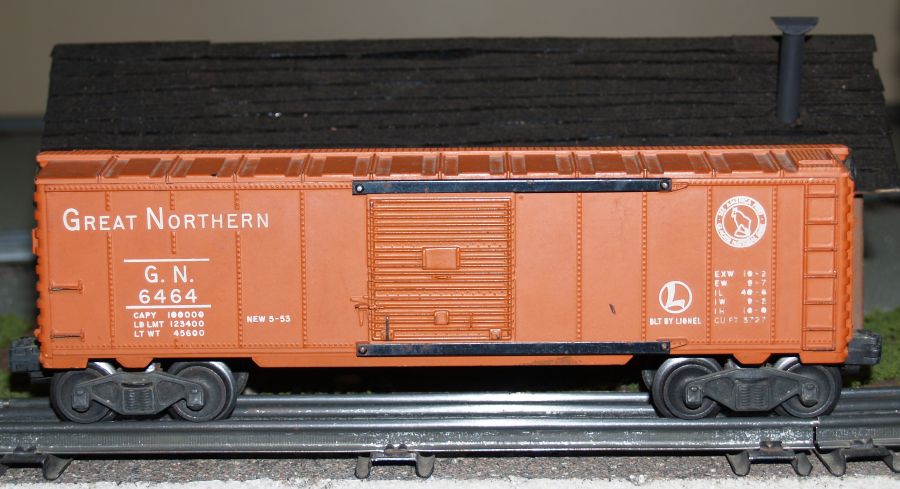 No. 6464-25 Great Northern Box Car
The picture above shows a Lionel #6464-25 Great Northern Box Car (manufactured from 1953-1954). The body of this car is painted flat orange with white heat-stamped lettering including the Great Northern herald.
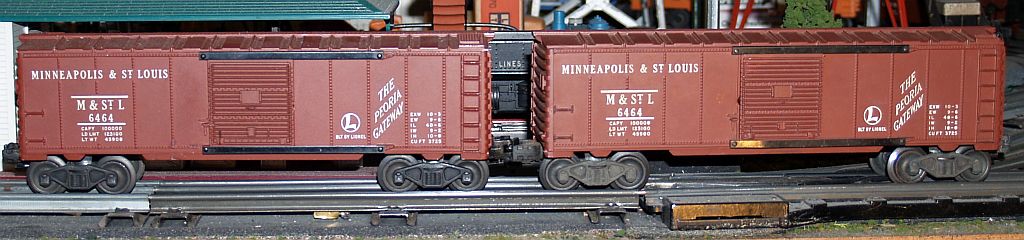 No. 6464-50 Minneapolis & St. Louis Box Cars
The picture above shows two identical Lionel #6464-50 Minneapolis & St. Louis Box Cars (manufactured from 1953-1956). The car has white heat-stamped lettering including the "M & ST. L THE PEORIA GATEWAY" logo. The single tack board doors are painted the same brown color as the body. The car has bar-end trucks with magnetic couplers. Based on the rivet pattern to the left of the door, both of these cars are some of the earliest of these cars produced.
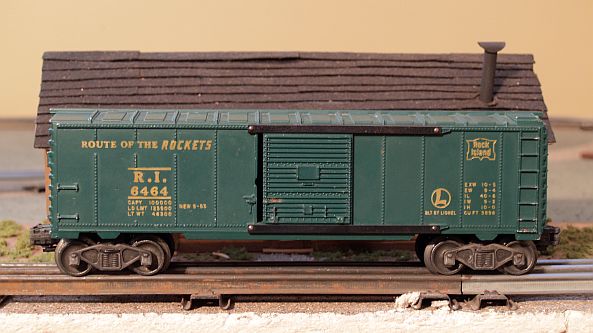 No. 6464-75 Rock Island Box Car
The picture above shows a #6464-75 Rock Island Box Car (manufactured from 1953-1954). The body of this car is painted green with gold heat-stamped lettering. The doors are also painted green. The complete 6464-75 number was not painted on the car - only "6464" was painted on the car.
hr size="4" width="100%">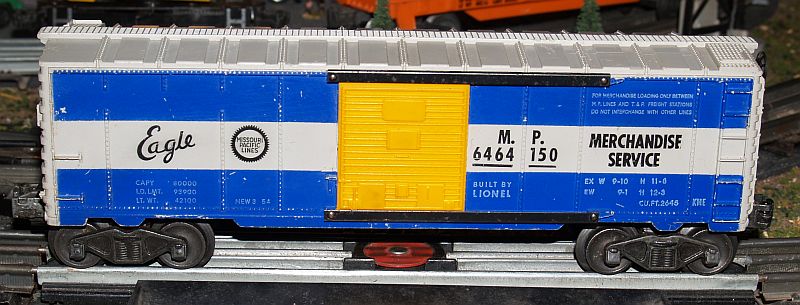 Lionel No. 6464-150 Missouri Packfic Eagle Box Car
The picture above shows a Lionel No. 6464-150 Missouri Packfic Eagle box car. The car has bar end trucks and the "Eagle" logo is to the left of the door.
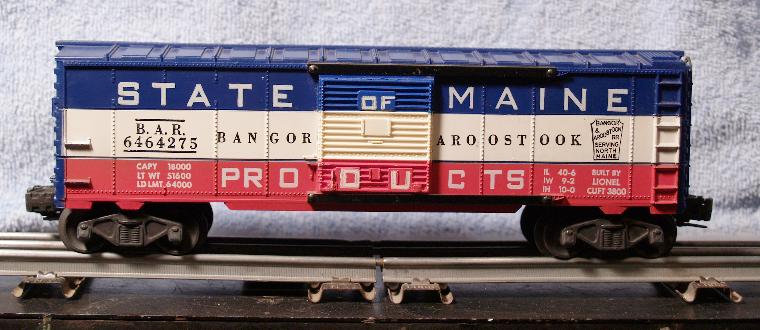
No. 6464-275 State of Maine Box Car
The picture above shows a Lionel #6464-275 State of Maine Box Car (manufactured from 1955-1959). This is a colorful box car with red, white, and blue horizontal stripes. On my car, the body is molded blue plastic and the white and red colors are painted on. My car has bar-end trucks indicating it is of the early production. It also has tab couplers.
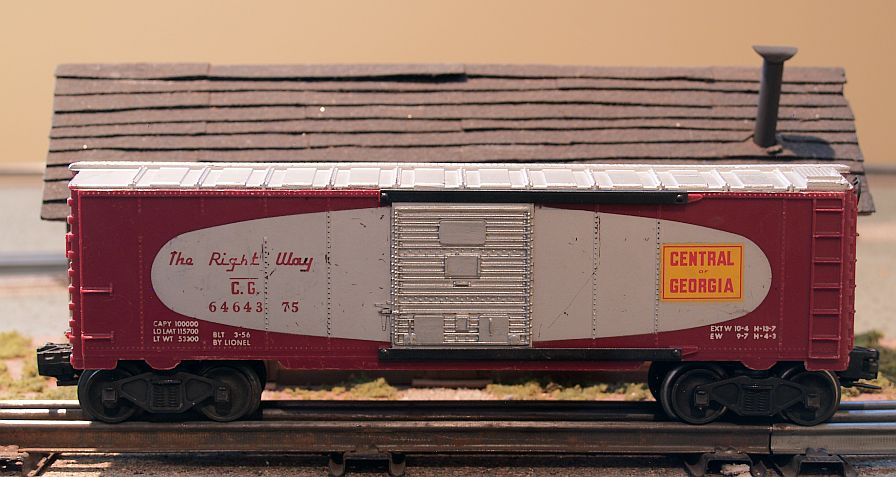
No. 6464-375 Central of Georgia Box Car
The picture above shows a Lionel #6464-375 Central of Georgia Box Car (manufactured from 1956-1957). This car has a maroon-colored body with a silver oval painted on the side. The roof is also painted silver. The lettering outside the oval is heat stamped. The Central of Georgia herald is a decal. My car has bar end trucks, one of which has a tab coupler - the other coupler does not have the tab.
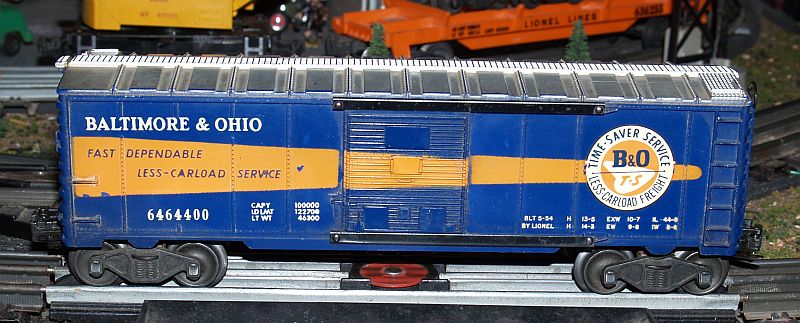
Lionel No. 6464-400 Baltimore & Ohio Box Car
The picture above shows a Lionel No. 6464-400 Baltimore & Ohio Box Car. This example features bar end trucks and has a built date of 5-54 on the side.
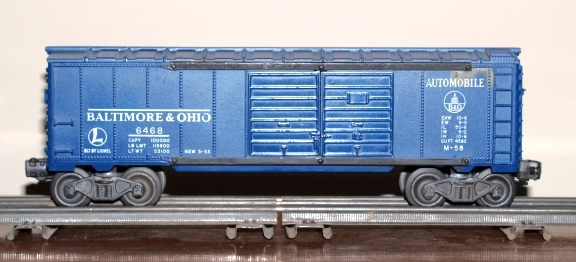
Lionel No. 6468 Baltimore & Ohio Automobile Transport Box Car
The picture above shows a Lionel No. 6468 Baltimore & Ohio Automobile Transport Car (manufactured from 1953-1955). This is a double-door boxcar and actual boxcars of this type were used to transport automobiles before the auto-loader and auto-rack railroad cars became popular. Note that the doors are not in the center of the car (horizontally). My car is in fairly good shape but there are some rust stains to the right of the doors below the upper door rail and on the other side near the bottom. My car is the more common blue car.
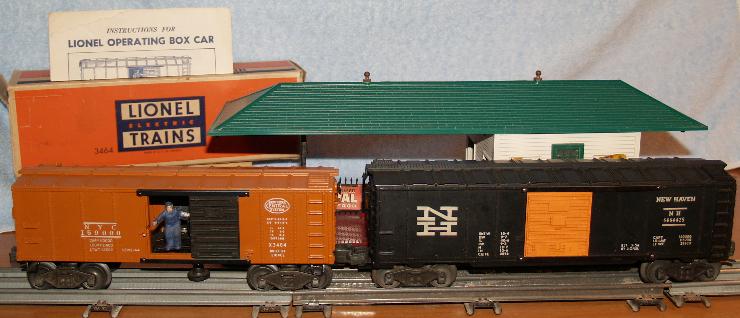
No. X3464 N.Y.C. Box Car and No. 6464-425 New Haven Box Car
The picture above shows a No. X3464 New York Central Box Car (manufactured from 1949-1952) and a No. 6464-425 New Haven Boxcar (manufactured 1956-1958) on a track in front of my No. 256 freight station. The X3464 is an operating boxcar. When the car is over an UCS remote control track section and the "uncouple" button is pressed, the door will slide open and the man inside will move toward the door as shown in the photo. My car is an older version as it has the staple-end trucks. Note that I have the original box and instruction sheet for this car. The New Haven boxcar is highly sought after for its contrasting colors. Mine has the unpainted black body and the "N" has the full Serif type font.
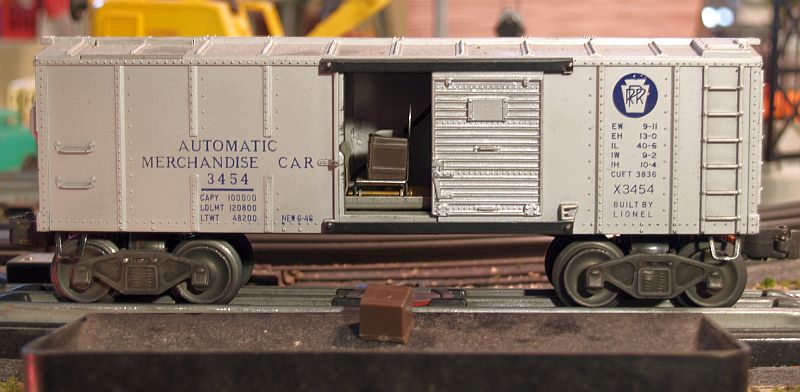
No. 3454 Automatic Merchandise Car
The picture above shows a #3454 Automatic Merchandise Car (manufactured from 1946 - 1947) that I have. This is one of the first operating cars produced after WWII. This 9 1/4-inch long car is painted silver and the PRR logo is blue. The car has opening die-cast doors. This car has cubes of brown plastic "crates" engraved with "Baby Ruth" that are ejected by the remote control track section after the door is first opened by remote control. Repeated remote control action ejects all of the crates, one at a time, and then the last remote control action closes the door. The crates are reloaded via roof hatch.
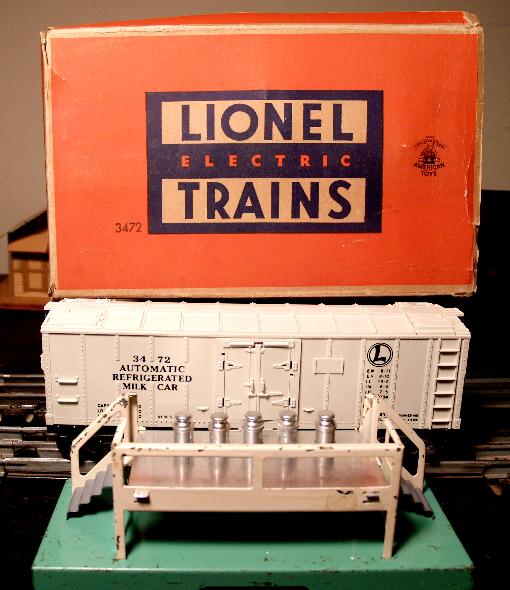
No. 3472 Operating Milk Car & No. 3462P Milk Car Platform
The picture above shows a #3472 Operating Milk Car (manufactured from 1949 - 1953) that I have. Five milk cans came with the car (the original set had 7 cans). I have the #3462P milk car platform, and the original box for this set. This set is probably Lionel's most popular accessory. This car is a reliable accessory and only occasionally needs cleaning and alignment. I had the platform with my original train set I received from my cousin, but later I purchased the car with the 5 cans and box. The #3472 Operating Milk Car is listed on page 28 of the 1952 catalog as shown below.
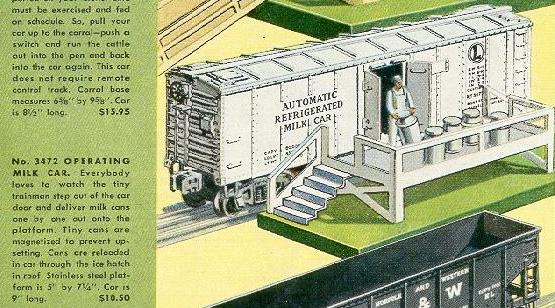
No. 3472 Operating Milk Car in 1952 Lionel Consumer Catalog
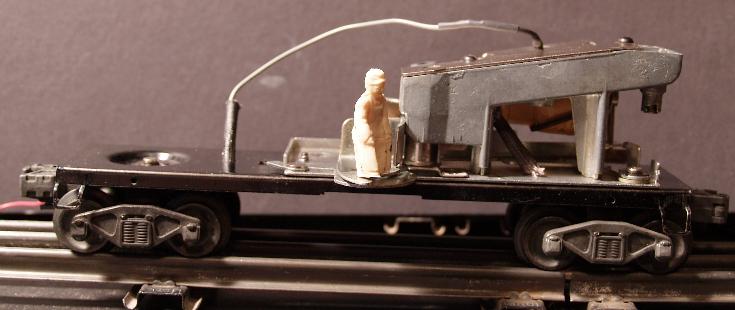
After I received the car, I rewired the car to replace the old wiring that was brittle and had cracked insulation. I adjusted and oiled the mechanism and now the car works well. Below are some pictures showing how the car works.
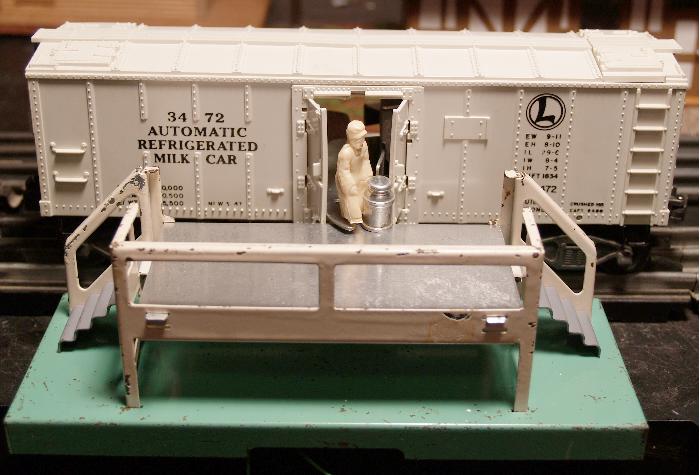
No. 3472 Operating Milk Car with Man Placing Milk Cans on Platform
The picture above shows the man inside the car placing a milk can on the platform. Although in this picture you can see through the door and out the door on the opposite side, the car has doors on both sides. I removed the door on the opposite side to manually activate the mechanism for taking this picture. Below are pictures showing the internal mechanism.
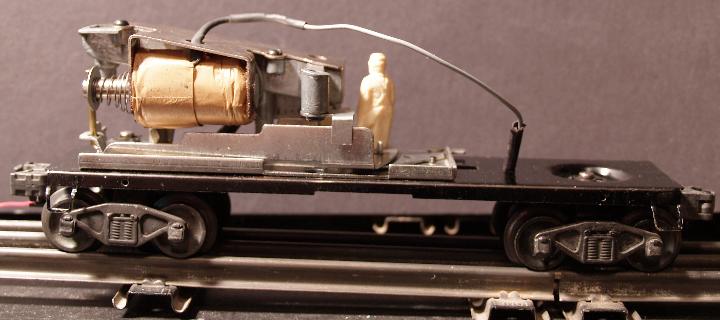
Internal Mechanism of No. 3472 Operating Milk Car
As shown above, the mechanism is fairly simple being driven by a single solenoid activated by a special track section that is used to unload my log and coal cars. The special track section also decouples cars. The milk cans are loaded into the car through a door in the top of the car. The cans roll down an inclined trough starting at the top left and ending just to the left of the milk man. You can see the solenoid in the left foreground. When activated, the solenoid plunger moves inward. Below is a picture of the other side of the car.
Internal Mechanism of No. 3472 Operating Milk Car Showing Milk Can to be Captured
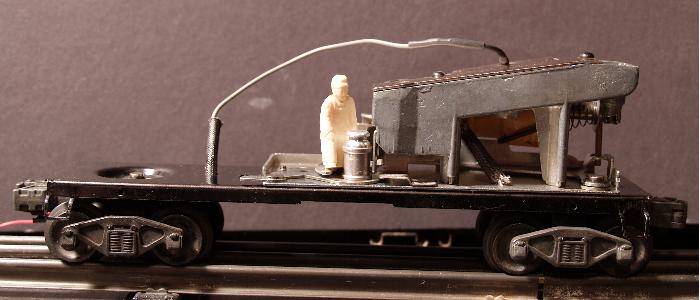
The picture above shows the solenoid activated the initial time after loading. At that time, a milk can falls out of the trough and is uprighted ready for the milk man to capture it. You can see the can just to the right of the man and partially obscured by the mechanism. The next time the solenoid is activated, the can is captured by the man as shown below.
Internal Mechanism of No. 3472 Operating Milk Car Milk Can Captured by Man
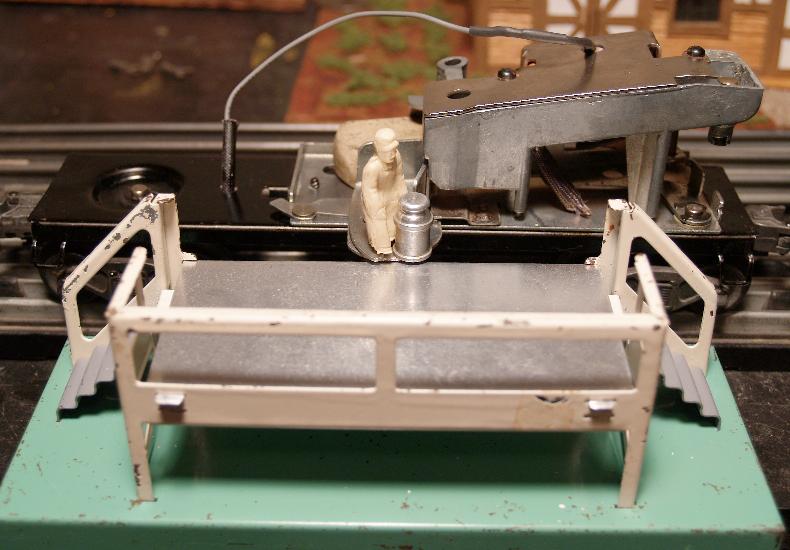
In the picture above, you can see the man has the can is ready to move it out of the car. The picture below shows the man placing the can on the platform.
Man in No. 3472 Operating Milk Car Placing Milk Can on Platform
In the picture above, the solenoid is fully activated and the man would be outside the car placing the can on the platform. The milk cans have a tiny magnet on the bottom to hold them on the mechanism. The platform deck is supposed to be steel so the cans will "stick" to it. I lost my original platform deck and I made a replacement from aluminum, but the cans do not "stick" to aluminum and skid significantly on the deck.
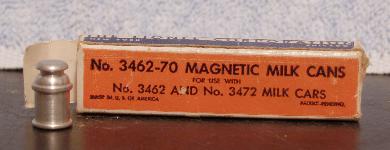
I acquired spare milk cans for the milk car. The spare milk can set is shown below in its original box. Lionel sold the #3462-70 milk can set as a replacement item or for use as extra detailing in a train layout. Note the box is lettered "For use with No. 3462 and No. 3472 Milk Cars." This lettering suggests it was manufactured between 1950 and 1957.
No. 3462-70 Additional Milk Cans
No train layout would be complete without a method to deliver the milk once the train transported the milk to its destination. Therefore, I acquired a diecast replication of the once famous 1950 DIVCO (Detroit Industrial Vehicle Company) milk delivery truck. This truck is shown below.
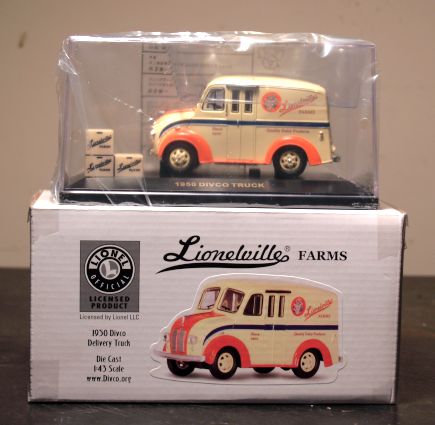
Diecast Model of a 1950 DIVCO Milk Delivery Truck
This diecast model is a Lionel Licensed Product manufactured in 2002 by Road Champs. It is a 1:43 scale model. It has written on the side "Lionelville Farms." Beside the truck are three crates containing milk bottles. This model has not ever been removed from its plastic case. The plastic bag surrounding the case is still sealed with the original tape.
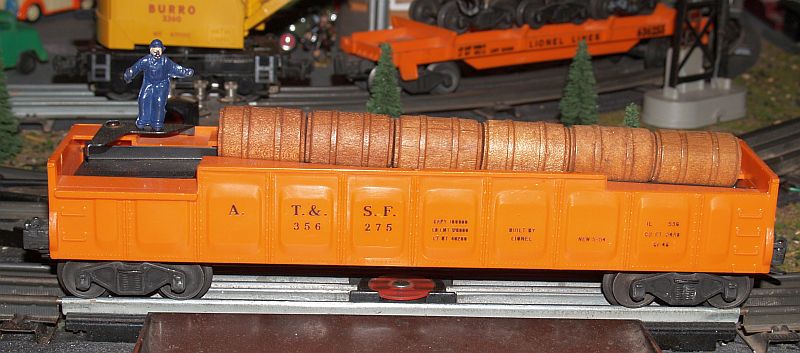
Lionel No. 3562 AT &SF Barrel Unloading Car
The picture above shows a Lionel Lionel No. 3562 AT &SF Barrel Unloading Car. The car contains an internal vibrator motor mechanism that when activated moves the barrels up the sloping metal trough to where the rubber workman "unloads" the barrels.
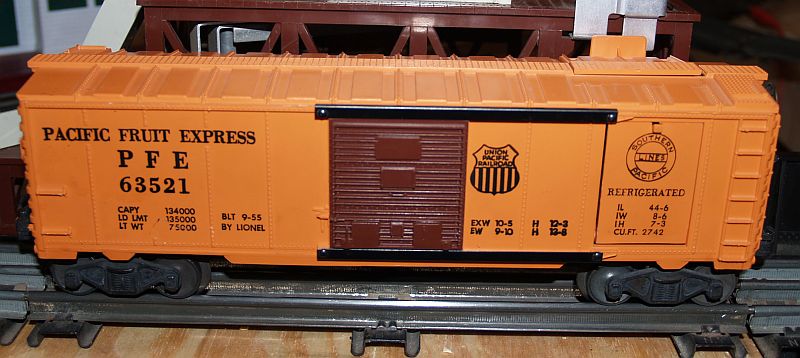
Lionel No. 6352 Pacific Fruit Express Refrigerator Car
The picture above shows a Lionel No. 6352 Pacific Fruit Express refrigerator car (manufactured from 1955-1957). This car was originally built to accompany the Lionel No. 352 Icing Station. The car has an unpainted orange body with black heat-stamped lettering. The number on the car is actually 63521. A special sliding roof panel allows the plastic ice cubes to be loaded from the icing station platform. There is a compartment inside to collect the ice cubes and a special door on the side (to the right of the brown door) allows access to the compartment to remove the cubes.
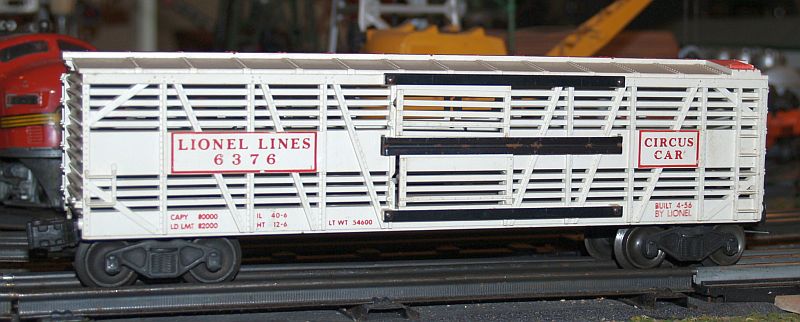
Lionel No. 6376 Circus Car
The picture above shows a Lionel No. 6376 circus car (manufactured from 1956-1957). This car is a large bi-level stock car. The body is unpainted white plastic with red markings heat-stamped in red. The roof walk is also painted red. The car has split doors with one for each level on each side. The car has bar-end trucks.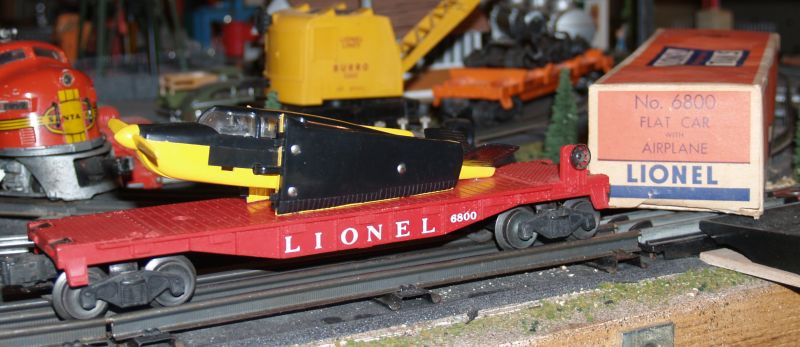
Lionel No. 6800 Flat Car with Airplane
This unpainted car includes a miniature Beachcraft Bonanza airplane with folded wings. This example has metal bar-end trucks and magnetic couplers and is the first version manufactured in 1957. The aircraft is molded in yellow and black plastic. This example has yellow on the upper surfaces and sports a yellow propeller. Note that I have the original box for this car.
As shown below, the bottom of the airplane bears the markings "No. 6800-60 AIRPLANE THE LIONEL CORPORATION NEW YORK, NY. MADE IN U.S. OF AMERICA."
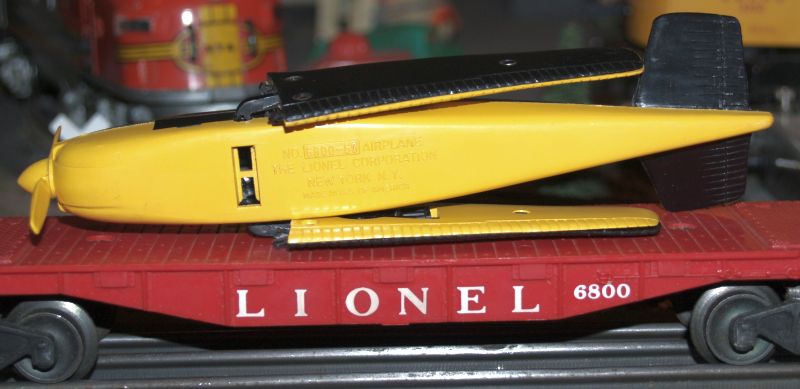
Lionel No. 6800-60 Airplane Bottom
The airplane wings will fold out and lock in place and the landing gear in the wings will support the plane sitting on the ground.
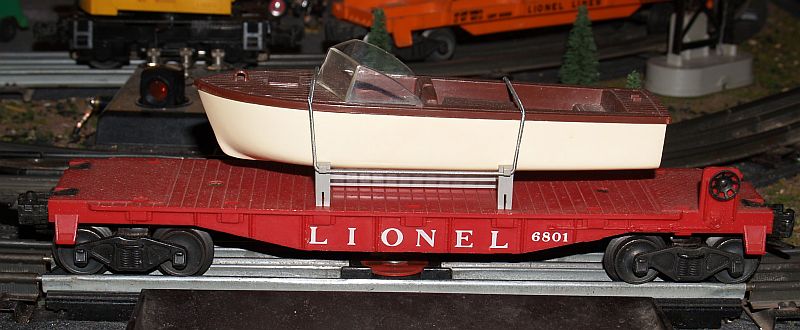
Lionel No. 6801 Boat Hauling Car
The picture above shows a Lionel No. 6801 Boat Hauling Car (manufactured from 1957 through 1960). This car features an unpainted red flat car carrying a boat in an unpainted gray cradle. An elastic band holds the boat in place. The example is an early version, manufactured in 1957 as it has bar end trucks and the boat is white with a brown deck.
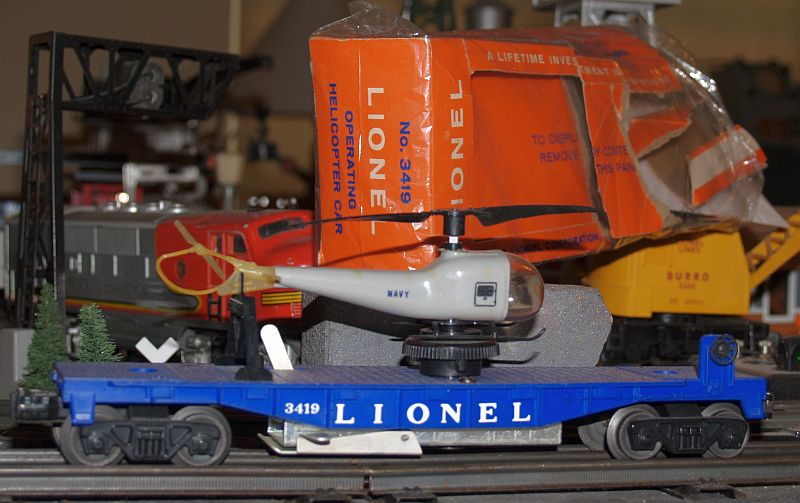
Lionel No. 3419 Operating Helicopter Car
The picture above shows a Lionel No. 3419 Operating Helicopter Car (manufactured from 1959 through 1965). This blue-plastic car has AAR-type trucks with operating couplers. A wind-up mechanism is mounted under the car and a spindle on tpo engages the bottom of the helicopter that mounted to the spindle. The tail of the helicopter is captured in a cradle at the end of the car. The mechanism is manually wound and the helicoper launched manually or via remote-control track section. This example is the later version car with the bright-plated mechanism and the translucent tail on the helicopter. This example has the original box, although not in pristine condition.
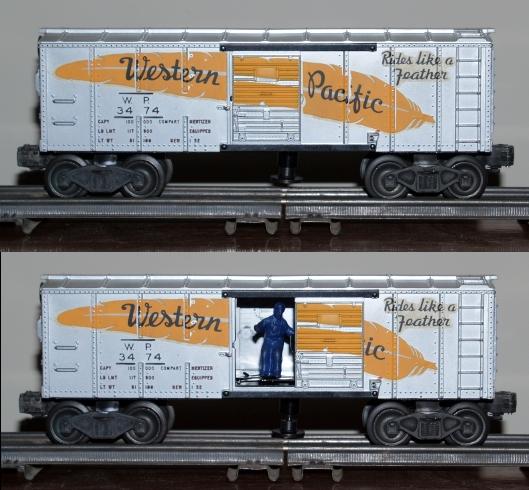
Lionel No. 3474 Western Pacific Operating Box Car
The picture above shows a Lionel No. 3474 Western Pacific Operating Box car (manufactured 1952-1953). This box car is the most colorful of the 9 1/4 inch operating box cars. Its body is painted silver and a large Western Pacific yellow-orange feather decal stretches most of the car's length. It also has a smaller decal with the Western Pacific "Rides Like a Feather" slogan in the upper right corner. The box car has an operating mechanism inside on which rides a blue rubber man. When the car is over the decoupling track section and the decouple button is pressed, the plunger on the bottom of the car is activated, the door slides open, and the man moves toward the door as shown in the lower photograph. I do not have the box for this car. My car works well.
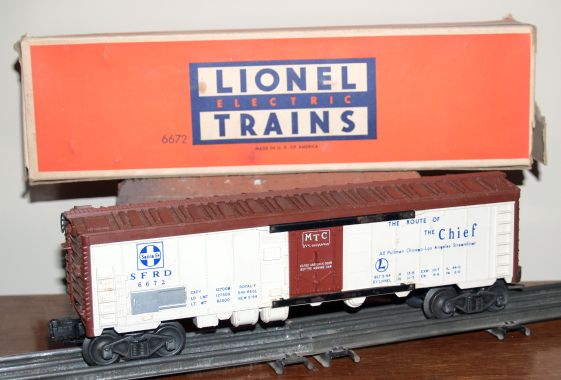
Lionel No. 6672 Refrigerator Car
The picture above shows a Lionel No. 6672 Refrigerator Car (manufactured from 1954 - 1956). This car has the Santa Fe markings (SFRD) and is a model of a mechancal refrigerator car. The car has no "ice hatches" like other refrigerator ("reefer") cars (such as the No. 3472 car above) because the car is "cooled" by mechanical temperature control (a refrigeration system). The car is longer than older "reefer" cars as this car is 10 1/8 incles long. The sides and floor of the car are molded a a single piece of unpainted white plastic and the roof and ends are molded as a single piece of unpainted brown plastic. The doors on either sides are molded of unapinted brown plastic and when in position over the door opening, a leaf spring in the door guide pushes them down into place. You have to pull the door outward slightly to open the door. Note there is an aluminum refrigeration control panel on the lower left. When you slide the panel to the left, controls are revealed and the manufacturer name Carrier is revealed. The picture below shows the panel opened.
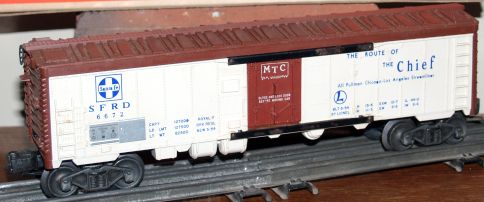
Lionel No. 6672 Refregerator Car with Refrigerator Control Door Open
The car has bar end metal trucks with tab couplers. My car is in good shape; however, there is some rust on the door guides. Note that I have the original box for this car. The box is in good shape with 397 marked on it. I presume that marking indicated the sale price; however, in the 1954 Lionel catalog, the factory recommended price for this car was $5.95. My car is the later version as there are 2 lines of data to the right of the door.
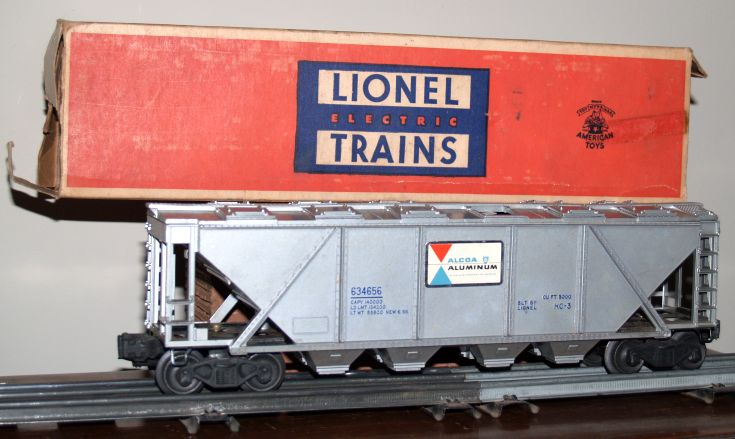
Lionel No. 6346 "Alcoa" Car
The picture above is a Lionel No. 6346 Alcoa Aluminum hopper car (manufactured 1956 only). This is one of the few covered hopper cars manufactured by Lionel. This car has a silver painted body, blue lettering, bar end trucks, one brakewheel, and a stick-on Alcoa Aluminum emblem on both sides. The actual number painted on the side is "643656." The car is long measuring 10 3/4 inches, not including the couplers on each end.
The cover has 12 hatches; however, mine has 2 hatches missing as the hatches are fragile and the hinges easily broken. Replacements can be obtained for the missing hatches. Note that I have the original box for this car. One of box end flaps is detached, but present, and the other is missing.
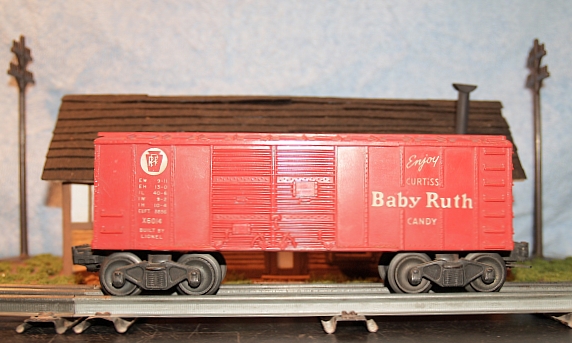
Lionel X6014 Baby Ruth Scout-Type Boxcar
The picture above shows a Baby Ruth Scout-type boxcar (manufactured 1951-1956). The doors on this inexpensive boxcar do not open and the brakewheel is molded into the plastic.
Passenger Cars
Below are pictures of the passenger cars that I have.
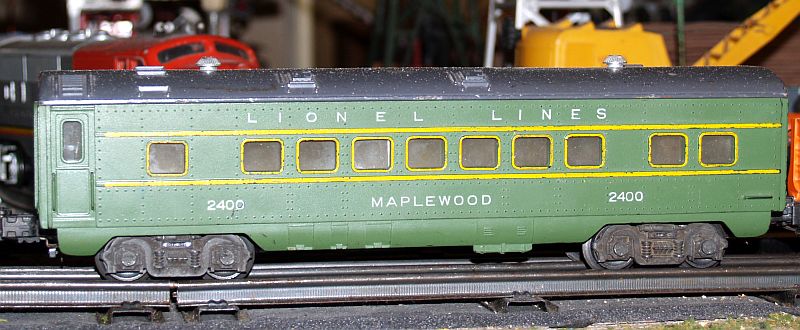
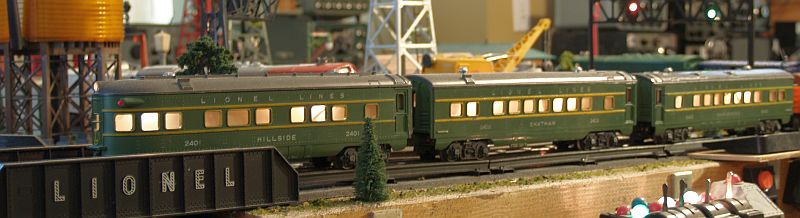
Lionel No. 2400 Maplewood Passenger Car
The picture above shows a Lionel No. 2400 passenger car (manufactured from 1948-1949). This car is one of three similar attractive passenger cars in the 2400 series. These plastic streamlined cars had bodies painted green with yellow stripes and yellow window outlines. The lettering on this Pullman was heat-stamped in white and the roof was dark gray. This car is illuminated with plain frosted window inserts. Maplewood is a town in New Jersey near the former Lionel manufacturing plant.
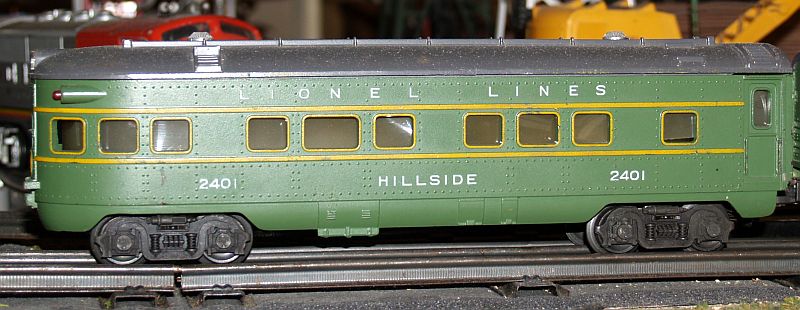
Lionel No. 2401 Hillside Passenger Car
The picture above shows a Lionel No. 2401 passenger car (manufactured from 1948-1949). This car is the observation car offered to accompany the 2400 and 2402 passenger cars. Its paint and markings is the same as the 2400 and 2402 cars. Hillside, New Jersey was the home of the Lionel manufacturing plant when this car was manufactured.
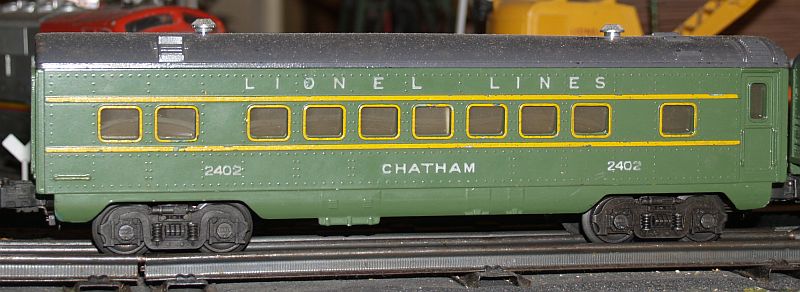
Lionel No. 2402 Chatham Passenger Car
The picture above shows a Lionel No. 2402 passenger car (manufactured from 1948-1949). The second Pullman car offered in 1948-1949 was the 2402 Chatham car. Its paint and markings is the same as the 2400 and 2401 cars. Chatham is a community in New Jersey near the former Lionel manufacturing plant.
Below is a picture showing all three passenger cars in a train and illuminated.
Motorized Units
Below are pictures of the motorized units that I have.
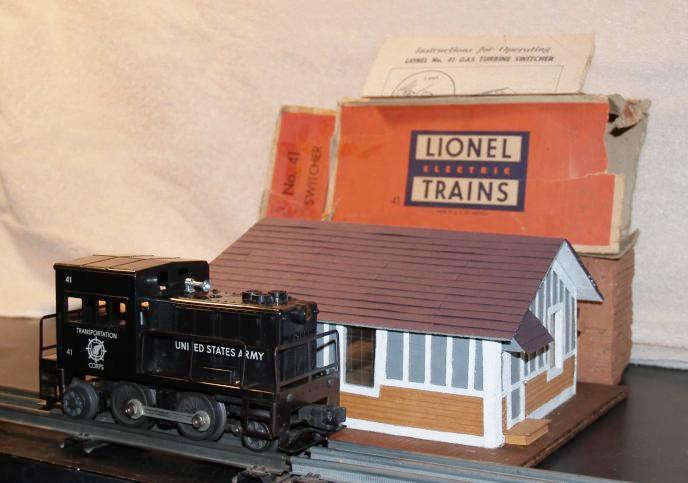
Lionel No. 41 Switcher
The picture above shows a Lionel No. 41 Switcher (manufactured from 1955-1958) that I have. This unit is modeled after the experimental gas turbine switching engine built by the Davenport Locomotive works for the US Army Transportation Corps. The prototype switcher is powered by two Boeing gas turbines. The top speed of the Davenport locomotive is only 35 mph and Lionel designed its version to also be considerably slower than their other road locomotives. The actual twin Boeing turbine-powered locomotive is preserved at the National Museum of Transportation in St. Louis, MO.
Both the real and Lionel versions are intended for light yard work and should not be expected to pull no more than 3-4 freight cars.
The Lionel No. 41 has a ornamental horn, three position E-unit, and operating couplers on the front and rear. My unit is made of black plastic. Note that I have the the original box and the attendant operating instructions. On the box, the price is written as $11.50. It is worth considerably more than that now. My unit works well both forward and reverse. All wondow struts are present; however two on one side are cracked. These struts are easily broken with your thumb when picking up the engine.
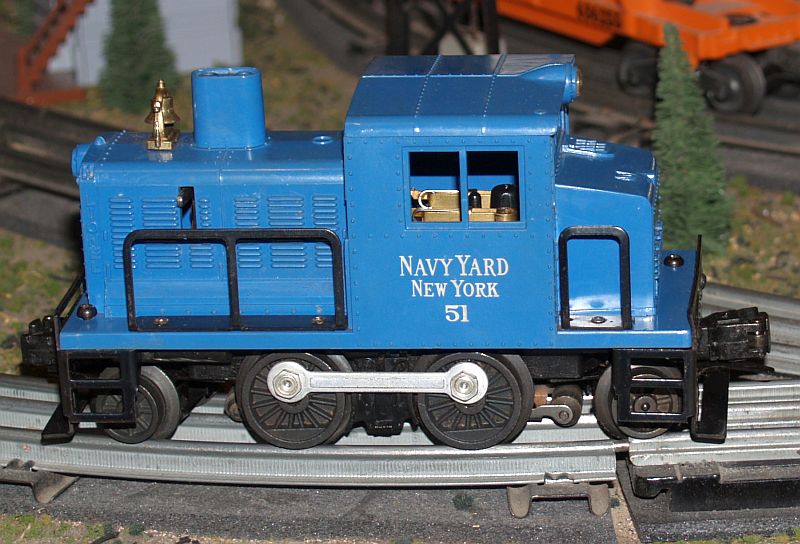
Lionel No. 51 Switcher
The picture above shows a Lionel No. 51 Switcher (manufactured from 1956-1957) that I have. This 2-4-2 unit is a replica of a 30-ton switcher built by the Vulcan Iron works of Wilkes-Bare, PA. The unit has white heat-stamped lettering applied to an unpainted blue plastic body. The body has blued-steel handrails and an ornamintal horn. It also has a three-position E-unit. The window struts are often missing on these units. Mine has both window struts, but both are cracked.
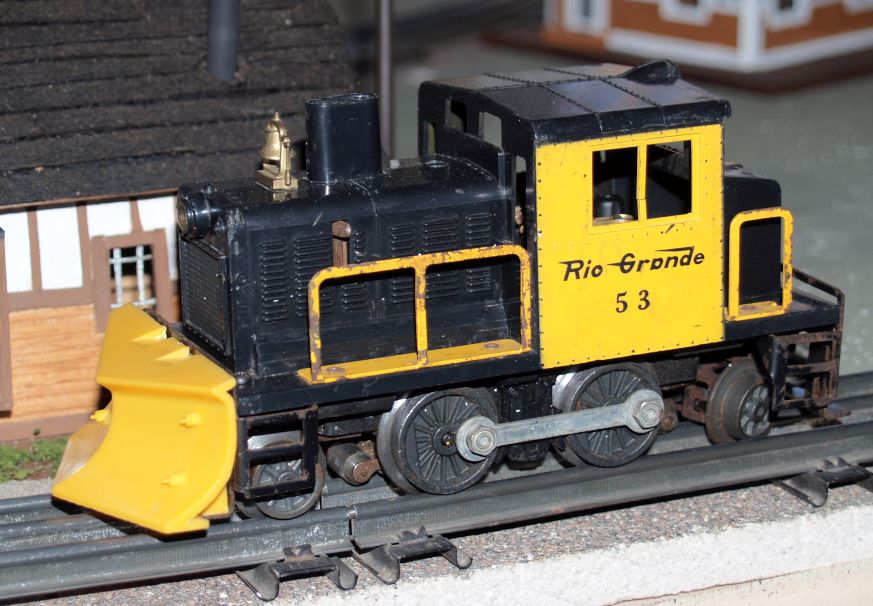 Lionel No. 53 Rio Grande Snow Plow
The picture above shows a Lionel No. 53 Rio Grande snow plow (manufacured 1957-1960) I have. This motorized unit unit is based on the Vulcan 2-4-2 switcher. The cab is painted yellow and the remainder is unpainted black plastic. There is an unpainted yellow snowplow blade on the front and an operating coupler on the rear. It has an E-unit internal that changes direction with power interruptions similar to my Santa Fe locomotive. Notice the window strut is broken but all of it is still there. The one on the other side is also broken. This is a common problem with these units as the struts are thin and is in the perfect place for your thumb to press it in when you pick the unit up.
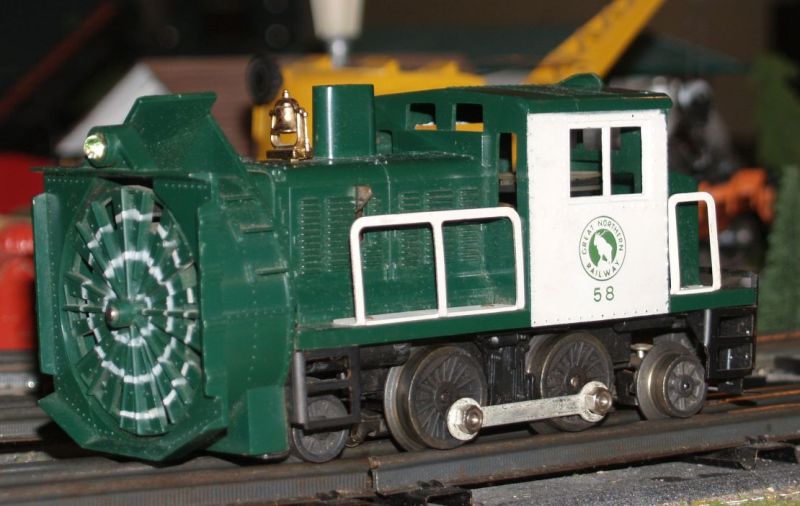 Lionel No. 58 Great Northern Rotary Snow Plow
The picture above shows a Lionel No. 58 Great Northern rotary snow plow (manufacured 1959-1961) I have. This motorized unit unit is based on the Vulcan 2-4-2 switcher, but it is heavily modified to include a rotary snow blower on the front. The blower actually turns as the unit moves down the track. It has an internal E-unit that changes direction with power interruptions. It has a operating coupler on the rear so the unit can pull small loads. The body is unpainted green plastic with white cab sides and heat-stamped lettering.
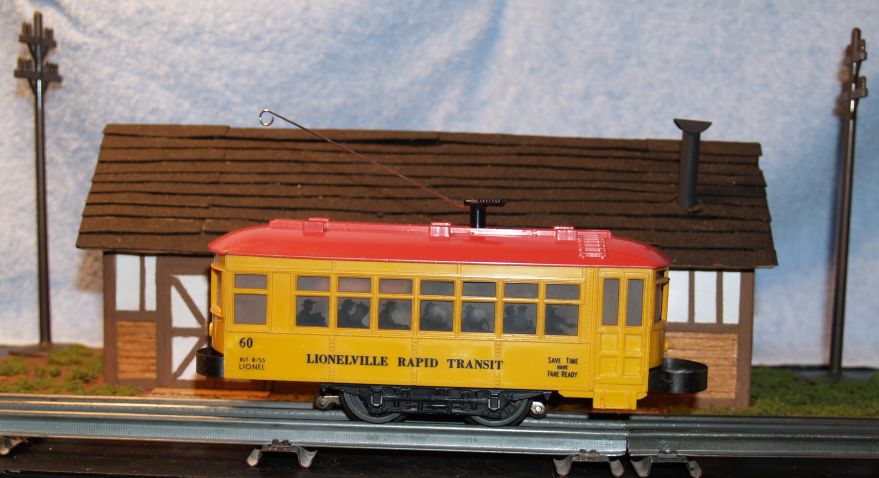
Lionel No. 60 Trolley With Black Lettering
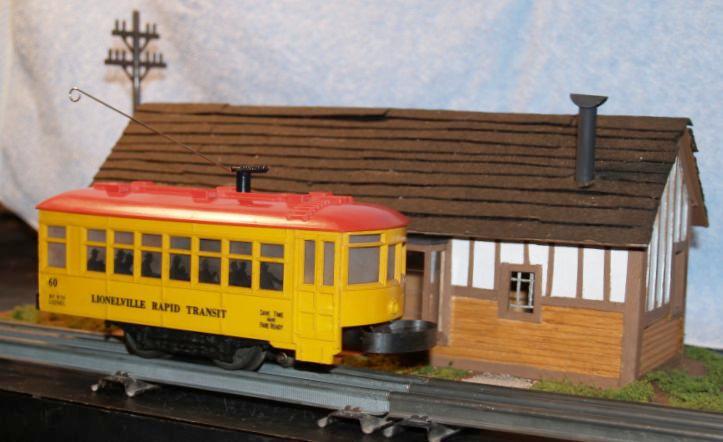
The picture above shows a Lionel No. 60 trolley (manufactured from 1955-1958). This unit is based on the Birney design and has a reversing mechanism similar to the No. 50 gang car. It has an unpainted yellow body and an unpainted red roof. The lettering was applied with heat-stamping. The lettering on this unit is black indicating it is a unit produced early in the production. This unit does not have the motormen that were included in the very first units.
The unit has a trolley pole on the top (that in a real trolley collected power from an overhead wire). The pole swings around in the opposite direction when the trolley strikes an obstruction. This unit has the two part spring-type bumpers on the front and rear that make the car reverse when it strikes an obstruction.
The inside of the car is illuminated and there are silhouettes of passengers printed on the frosted windows.
When I received this item, I had to perform some repairs: resolder the 2 field coils wires, replace the motor ball bearing, repair one motor brush, take the car apart and oil and regrease it, replace the interior lamp, clean the entire car. The result of this work produced a gool-looking car that runs very well.
Click on the picture below and you can see a short movie of the car in action. The continuous "buzz" you hear is the vibrotor of the No. 155 Ringing Signal next to the train station. The bell of the ringing signal is difficult to hear in this video.
I also have a Lionel No. 60 trolley with blue lettering with its original box as shown below.
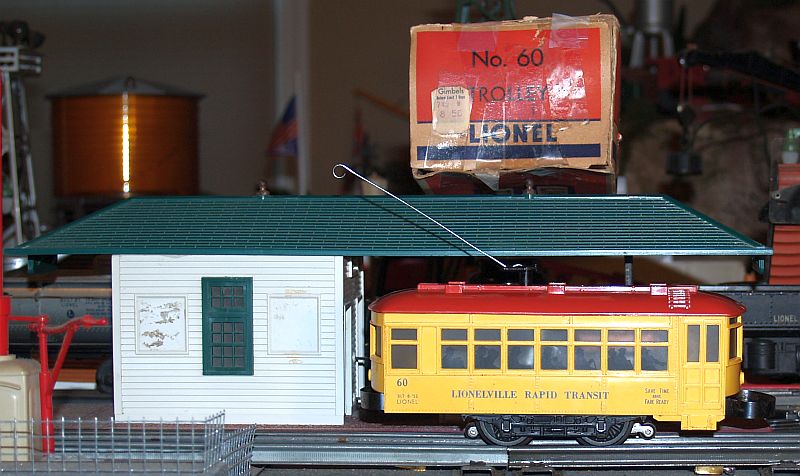
Lionel No. 60 Trolley With Blue Lettering and Original Box
This unit is identical to the Lionel No. 60 Trolley with black lettering shown above except the lettering is blue. This blue lettering trolley also has the two-part spring bumpers. When I received this unit, I had to perform some minor repairs: repair the tabs inside the car that held one end of the roof in place, clean and grease the motor armature, and re-attach the metal pinion gear to the trolley pole shaft. Apparently, when someone tried to remove the trolley pole, it was stuck to the shaft and pulling hard, pulled the pinion gear off the shaft. Fortunately, the pinion gear remained in the car.
Note the price for the trolley as seen on the tag on the box was $8.50.
Below is a picture of both trolleys.
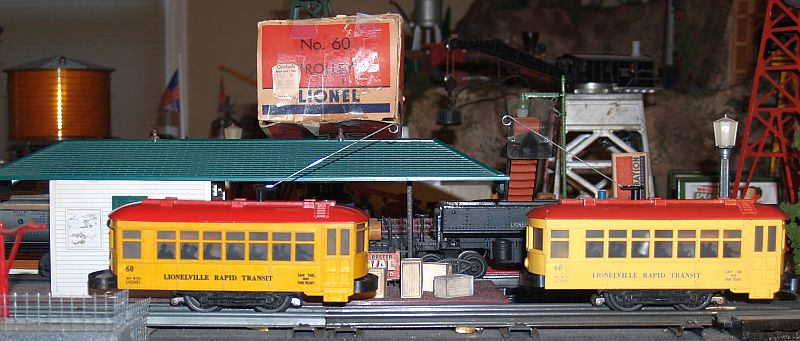
Lionel No. 60 Trolleys, One With Black Lettering and the Other With Blue Lettering
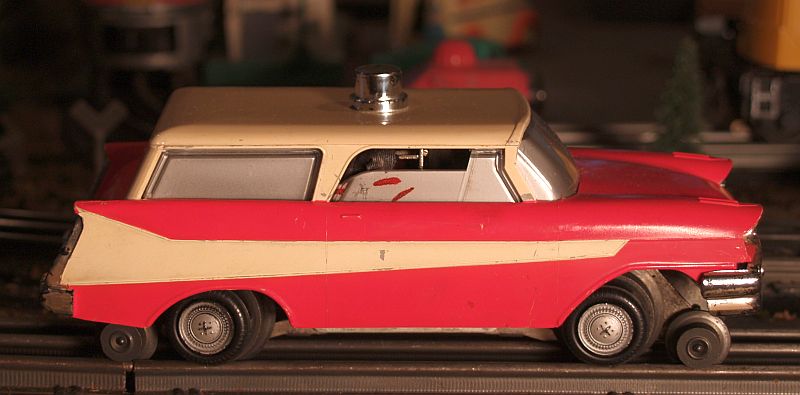
Lionel No. 68 Executive Inspection Car
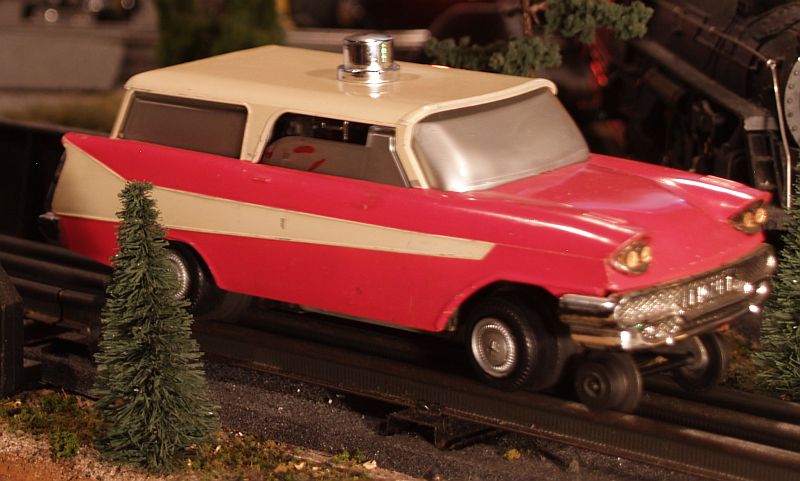
The picture above is a Lionel No. 68 Executive Inspection Car (manufactured 1958 - 1961). This motorized unit resembled a 1958 DeSoto station wagon equipped with a Hy-Rail device allowing it to operate on railways. The unit has a 2-position E-unit that is turned off an on by a switch, the knob of which is vaguely disguied as a warning beacon on top of the car. The E-unit does not have a center neutral. The car goes either forward or backward as the track power is cycled off and on.
Lionel No. 69 Maintenance Car
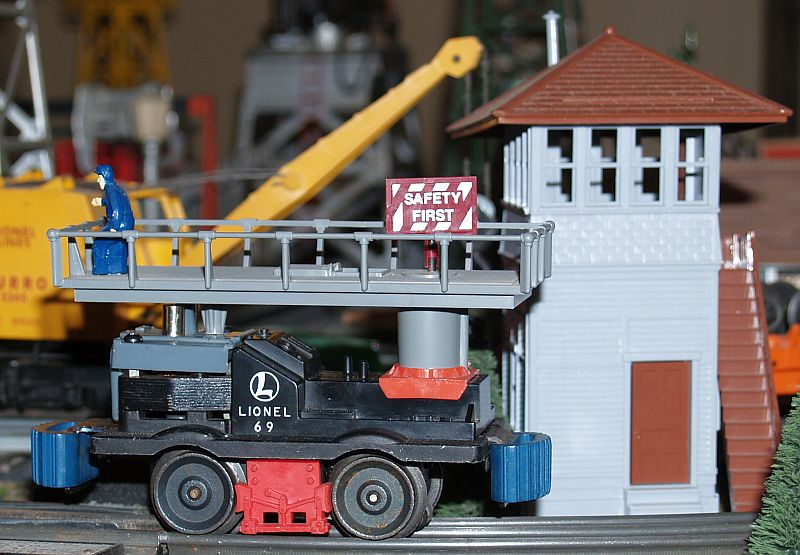
The picture above is a Lionel No. 69 Maintenance Car (manufactured 1960 - 1962). The design of this car is based on the Lionel No. 50 Gang Car. The motor brushplate was molded in dark gray plastic. The modified gand car body was unpainted black plastic wih white heat stamped markings. A light gray plastic platform was mounted above the body. On one end of the platform was a red plastic sign with "Safety First" on one side and "Danger" on the other side. The sign rotates when the car reverses direction after the bumpers hit an obstruction. A rubber man was stationed on the other end of the platform.
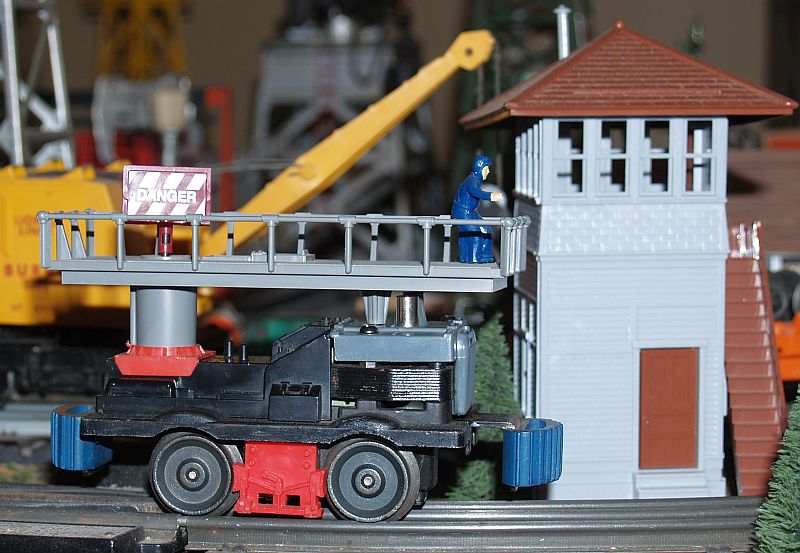
Lionel No. 69 Maintenance Car
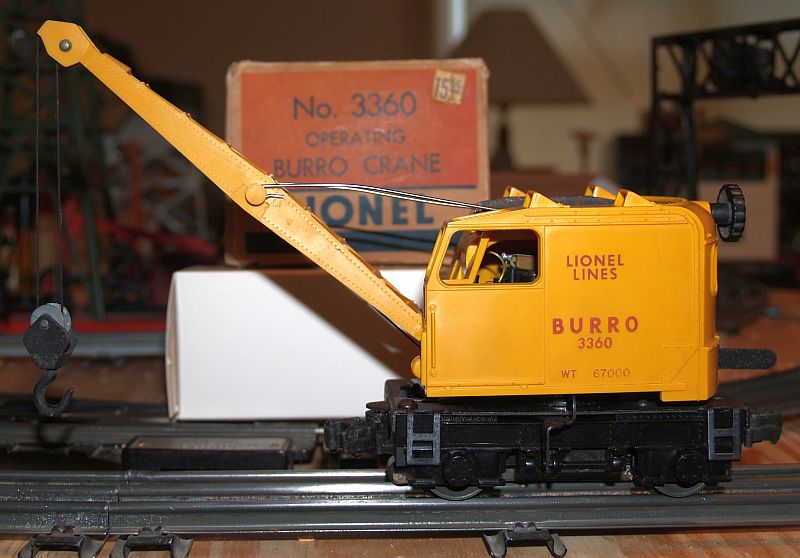
Lionel No. 3360 Burro Crane
The picture above shows a Lioenl No. 3360 crane (manufactured from 1956-1957). This self-propelled crane is a replica of the small crane manufactured by Cullen-Friestedt of Chicago for railroads. The body of the Lionel crane is molded in yellow and has red heat-stamped lettering. The crane can go backwards and forward with the direction controlled by a lever on the side shown that could be moved by a track-side activator. A lever on the opposite top side controls whether the crane moves or the cab rotates - the direction depending on the position of the lever on the side. That lever can also place the crane in "neutral" (middle position) so it does not move. The lever on the back of the cab disables cab rotation and allows the operator to raise and lower the block and tackle - the direction up or down depending on the position of the lever on the side. The crane has a non-operating coupler on each end to allow it to pull light loads. I have the original box with the insert for this crane. Note the price when purchased new is on the box and the price was $15.95.
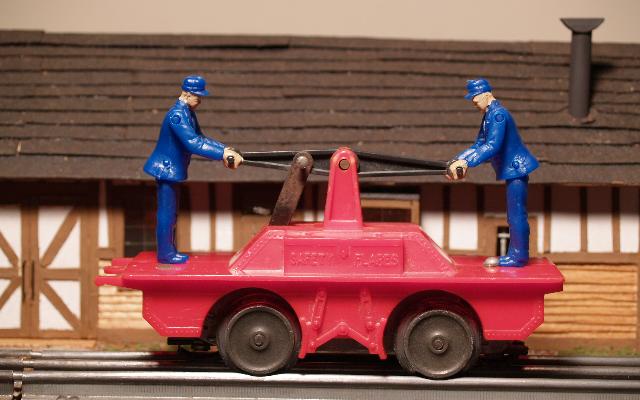
Model 2002 Handcar Manufactured by Louis Marx & Co.
The picture above shows a two-person handcar (Model 2002) manufactured by Louis Marx & CO, Inc. The car was the second version of this model and was manufactured from 1955 to 1956. This car is electrically powered and controlled with the transformer like a locomotive. For a long time the two railroad workers on each end of the arm were missing. I found a source of repair parts and replaced them as shown above. The car supposed to have one blue and one gray man. As the car goes down the track, the men appear to pump the arm up and down.
I understand this red version is relatively hard to find. The previous version was also red but the two men were yellow. The subsequent version was brown with blue and gray men. My car does have some damage - there are two short bumpers broken off one end and part of the top of the car is also broken on one side. One of the handles for one of men is also broken. These defects do not significantly detract from the car.
I also have acquired the brown version. Below are pictures of the brown version with the blue and gray men and the original box.
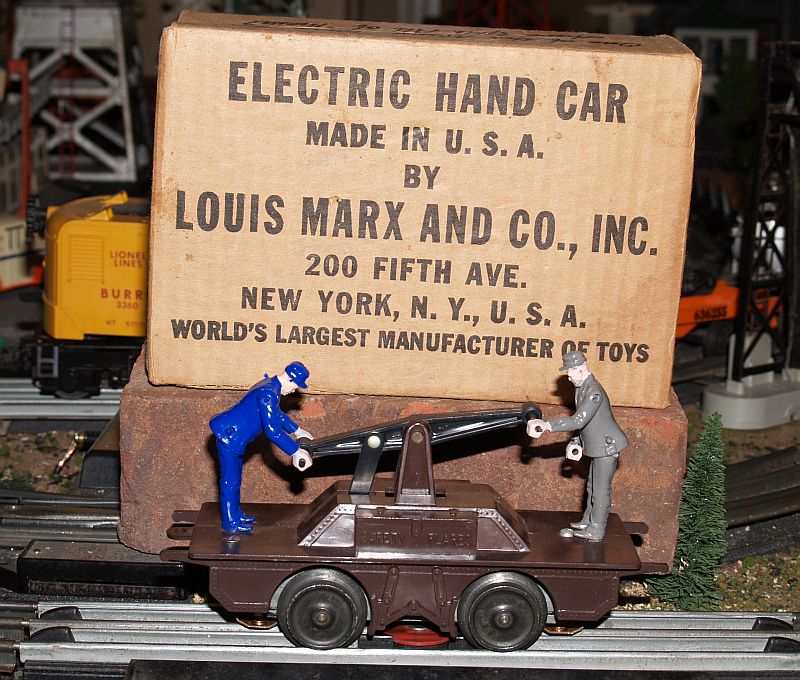
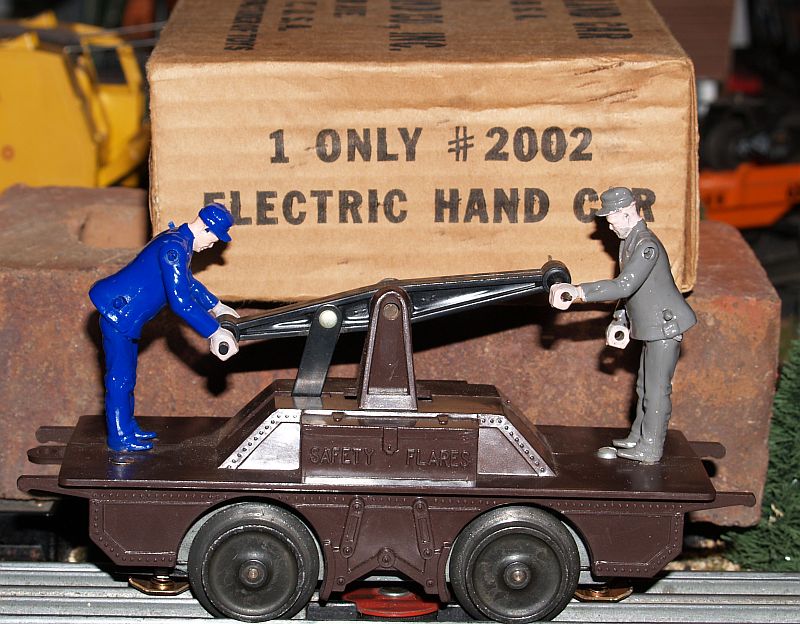
Model 2002 Brown Handcar Manufactured by Louis Marx & Co.
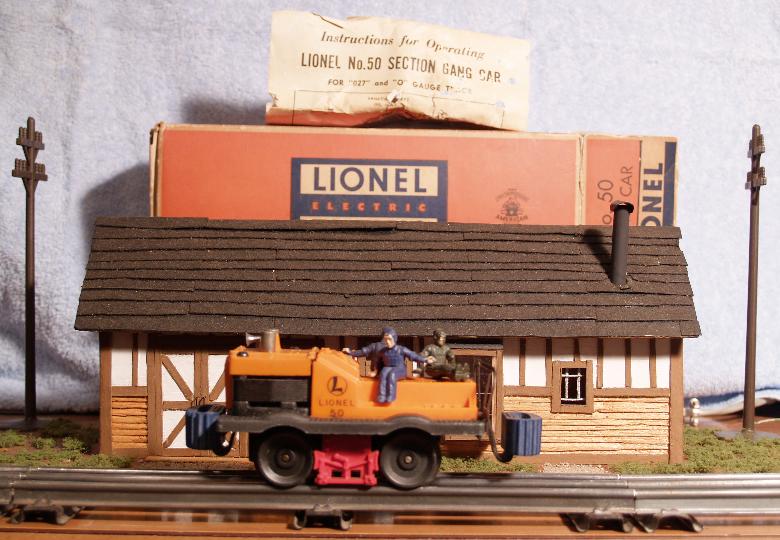
Lionel No. 50 Section Gang Car
The picture above shows a Lionel No. 50 Gang Car (manufactured from 1954-1964). This was the first of the series of motorized units that Lionel manufactured. This car is self-propelled and has 3 men, two blue and one olive-colored. The car has an unpainted orange body and brushplate and an ornamental horn. The car has two blue rubber bumpers on either end and when one of the bumpers strikes an obstruction, the car reverses direction and the olive-colored man rotates to the other side of the car. This car was relatively inexpensive and is small.
I believe my car was manufactured between 1955 and 1959 because the bumper bracket is U-shaped. Later versions were L-shaped. Note that I have the original box with the operating instructions. The box also contains the carboard insert. This car runs very well.
The No. 50 Section Gang Car as shown on page 8 of the 1959 Lionel Consumer Catalog is shown below. Note the price was only $7.95.
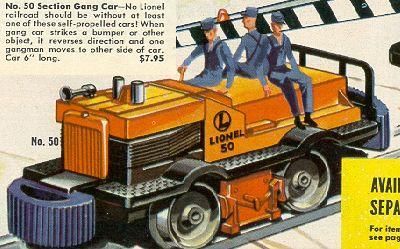
No. 50 Section Gang Car as Shown on Page 8 of the 1959 Lionel Consumer Catalog
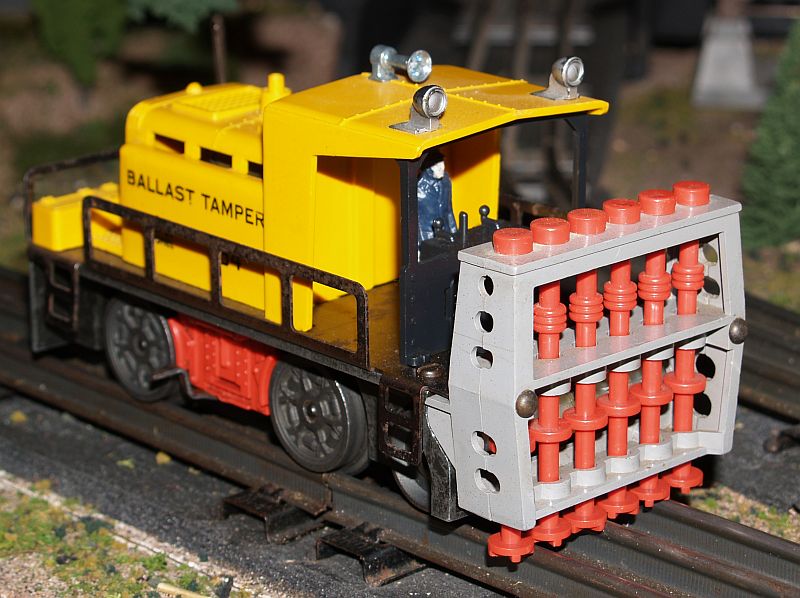
Lionel No. 54 Ballast Tamper
The picture above shows a Lionel No. 54 Ballast Tamper (manufactured from 1958-1961). This unit moves only in the forward direction. On the front of the unit is the gray housing for the tamper bars. Activation of the tampers is controlled by a railside trip that when the unit passes by, it slows down by about 50% and the tampers alternately go up and down until it passes by another railside trip and then the tampers stop, and the unit resumes nornal speed.
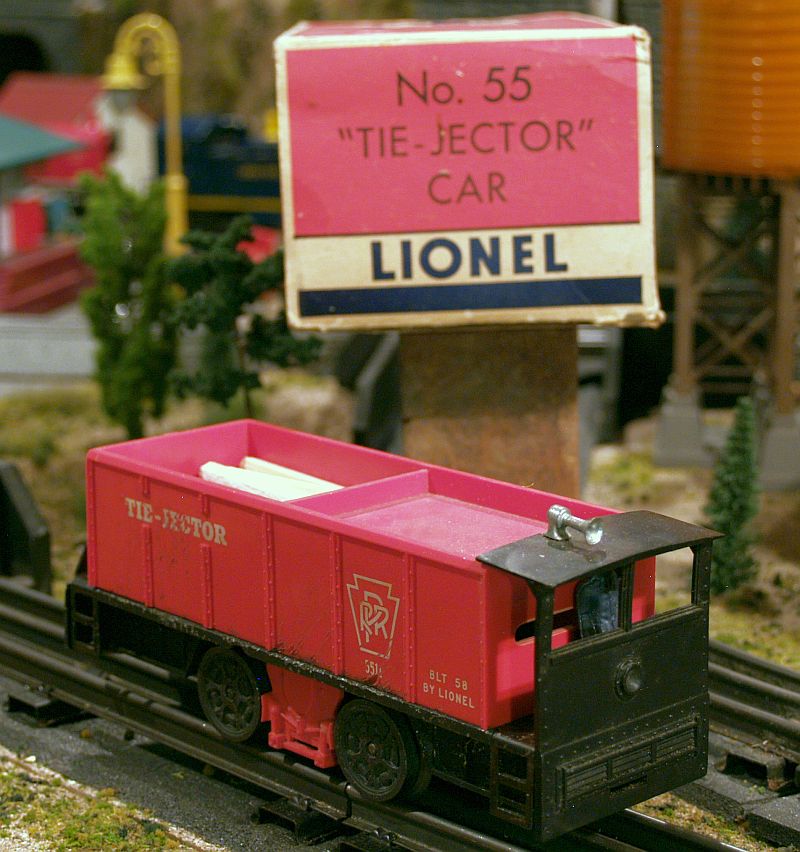
Lionel No. 55 Tie Jector Car
The picture above shows a Lionel No. 55 Tie Jector Car (manufactured from 1957-1961). The unit carries wooden crossties and when it passes by a trackside trip, it dispenses the crossties at intervals along the trackside until it passes by another trackside trip at which time the dispensing stops.
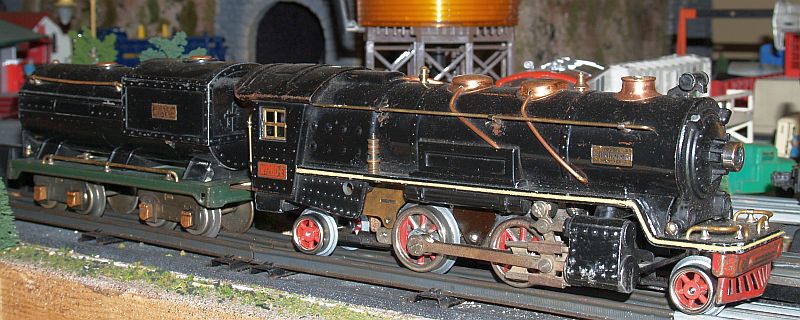
Lionel No. 260E Steam Engine & No. 260T Tender
The picture above shows Lionel's 260E locomoive and 260T tender. This locomotive was introduced in 1930 and at that time was Lionel's top of the line locomotive. This example is the early version built in 1930 with the cream stripe painted on the side of the running board. The running board is part of the die cast frame. This example has a pendulum-type two-position E-unit and when cycled by track power, it changes from forward to reverse. There is no neutral positon in the E unit. The example above does not have the "chugger" mechanism as was included in later units, but it does have an operational white headlight and a red light beneath the cab to simulate the hot firebox.
The 8-wheel tender above is not the tender that originally came with the locomotive. The original tender has a cream stripe along the side and a black base. The tender above does not have the stripe and the base is green. Otherwise, the tenders are the same.
When I received the engine, it needed some work but it did run. The rear trailer truck was missing and the cotter pin and cotter pin post were missing from the locomotive frame. Both crank rods and screws to hold them on were missing. One of the two fiber intermediate gears and pinion had missing teeth. And the wires and washers for the two lamps were missing as well as the lamps. The lens for the headlight was also missing. I was able to purchase replacement parts for all of them and now the locomotive runs quite well. The picture below shows the underside of the engine. You can see the cotter pin post I made at the left in the picture. Instead of a cotter pin, I used a screw and a nut to hold the truck in place.
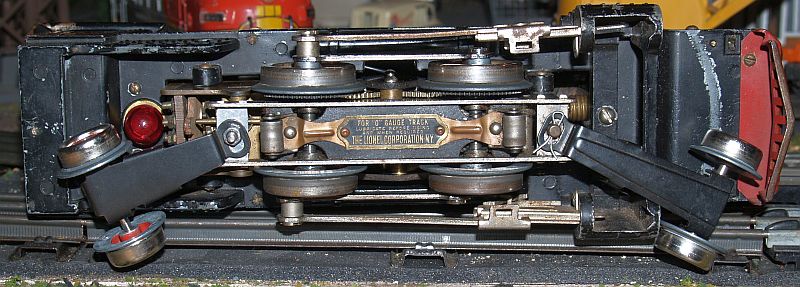
Lionel No. 260E Steam Engine Underside
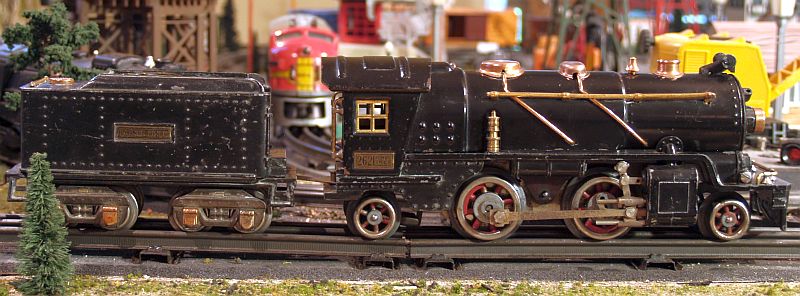
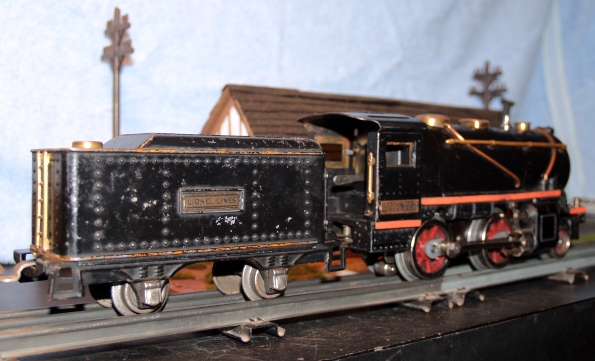
Lionel No. 262 Steam Engine & No. 262T Tender
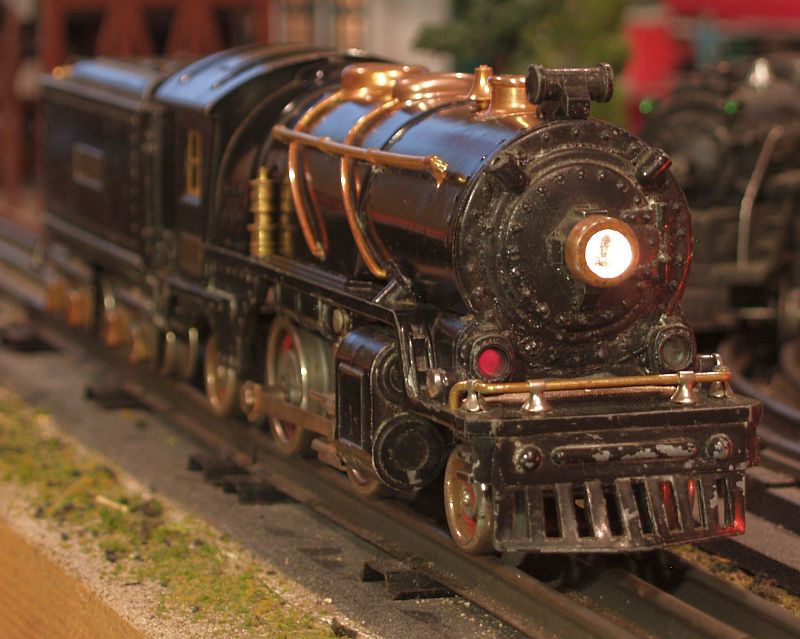
The picture above shows Lionel's 262 locomoive and 262T tender.This locomotive has a 2-4-2 wheel configuration and was manufactured from 1931 to 1932 and at that time was Lionel's "mid-level" locomotive. Also shown is the attendant 262T tender. This unit does not have an electronic reversing unit. Instead, there is a lever inside the cab where one can manually switch direction from forward to reverse. Up is forward and down is reverse. Once can place the lever midway between and the locomotive is in "neutral."
The locomotive has copper and brass trim. When I received the locomotive, the front sand dome and ornamental bell were missing. In addition, the screws on both sides that form "hinges" for the boiler front to open for lamp bulb replacement were missing. But the locomotive did run and the lamp was good. I acquired a brass sand dome and painted it copper. I also acquired a copper ornamental bell for replacement. And I acquired two screws for the boiler front. After replacing some internal wiring, the insulation of which has rotted, cleaning the motor commutator and brushes, and adjusting the collector to press harder on the center track rail, the locomotive runs as good a new. I also washed the locomotive with mild soap and water and used car wax to clean it up. It looks almost as good a new considering its age.
Below are some other pictures of the locomotive; one picture shows the headlight on.
Lionel No. 262 Steam Engine Headlight On
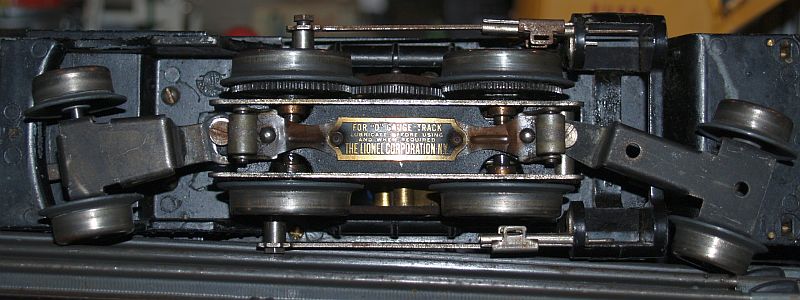
Lionel No. 262 Steam Engine Underside
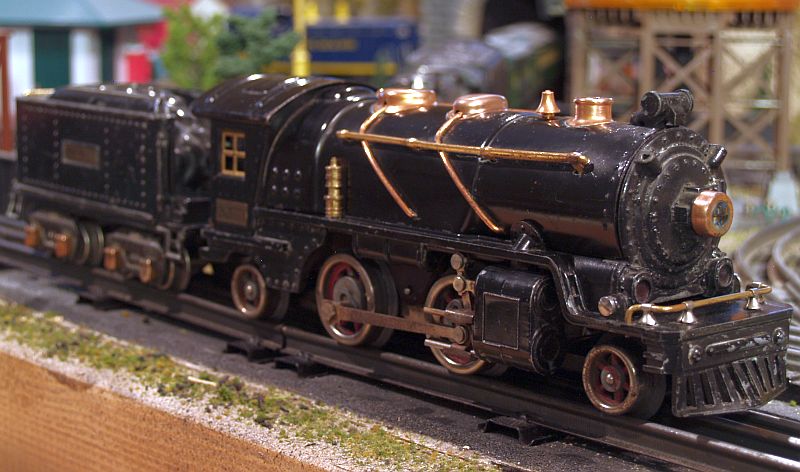
Lionel No. 262 Steam Engine & No. 262T Tender
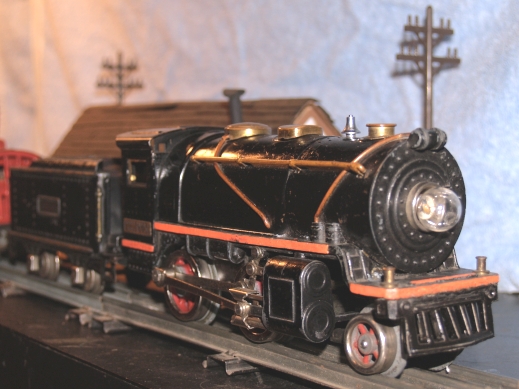
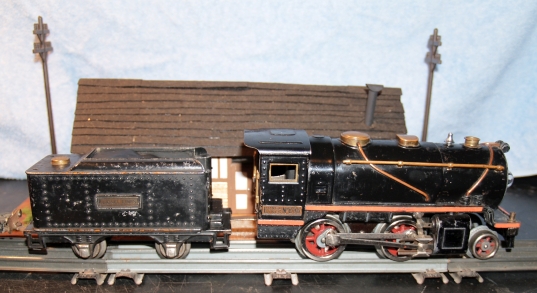
Lionel No. 258 Steam Engine & No. 257T Tender
The picture above shows a Lionel tinplate steam engine and associated tender. This engine and tender were manufactured in 1930 shortly after Lionel acquired sole ownership of Ives Manufacuring Company. The 258 is identical to the Lionel 257 engine except the 258 has a manual reverse lever. The 258 engine is interesting as it has brass and copper trim with orange-red stripes painted on. This example has the origial paint as it is somewhat pitted and scratched off in several places. But the engine runs well. I believe the 4 drive wheels are replacement because the red-painted spokes are not dull. But the front pilot wheels are original, I believe. Below is a picture of the engine with power applied to the track and the headlight on.
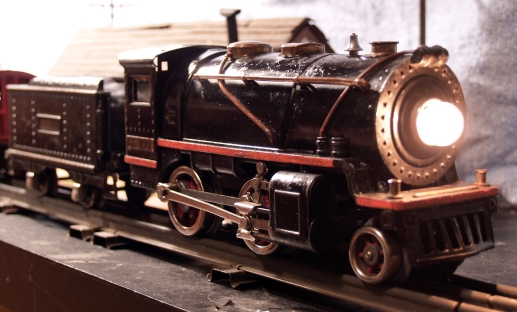
No. 258 Steam Engine with Headlight On & No. 257T Tender
Below is a picture of the side of the engine.
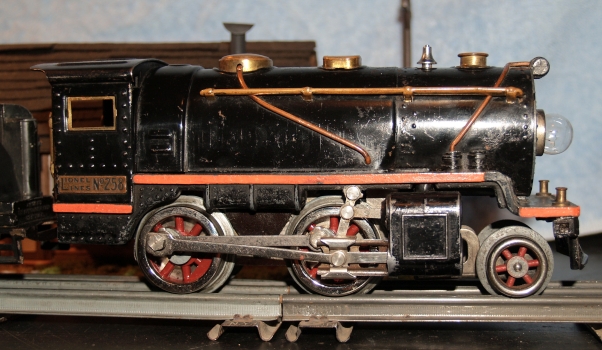
No. 258 Steam Engine
Below is a picture of the bottom of the engine. Note both power pickup rollers are original and in tact. Often, one of the rollers are broken or the roller assembly has been replaced. This example has the original roller assembly with the Lionel name.
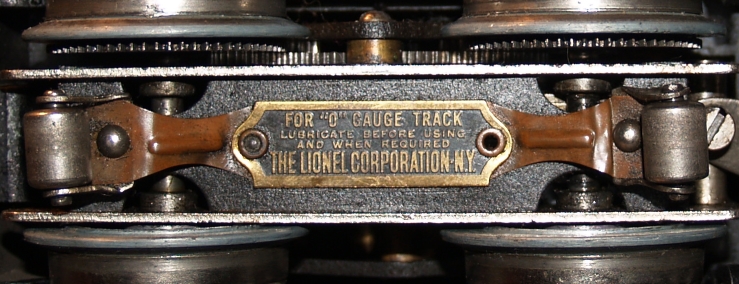
No. 258 Steam Engine Pickup Roller Assembly
The tender is also in good shape. The paint on it is also pitted. The tender is missing the brass handrail on the top rear, but it has the brass ladder on the rear. Below is a picture of the tender. The tender has the coal pile that is often missing.
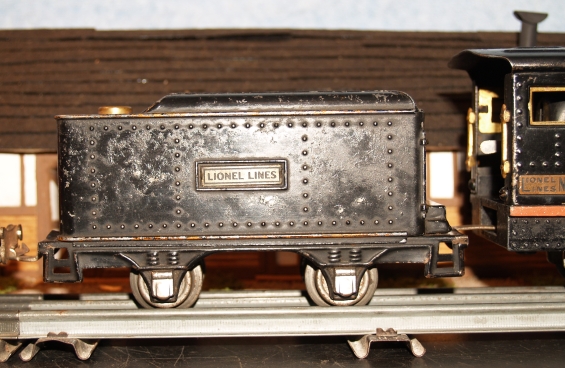
No. 257T Tender
The picture below is a picture of the engine and tender seen from the rear. The lever in the engine cab is the manual direction control. This engine does not have the "E-unit" used to remotely change direction of the train. When the lever is placed in the center position (level) the train is in "neutral".
No. 258 Steam Engine & No. 257T Tender
No. 258 Steam Engine & No. 257T Tender
Below is a picture of the 258 engine and 257T tender pulling four cars.
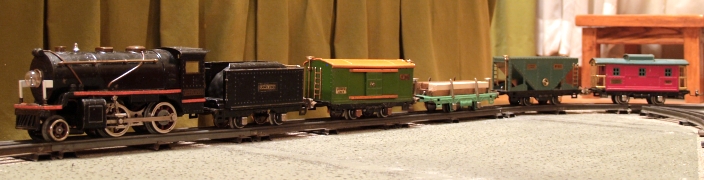
No. 258 Steam Engine, No. 257T Tender, No. 805 Boxcar, No. 831 Lumber Car, No. 803 Hopper Car, & No.807 Caboose
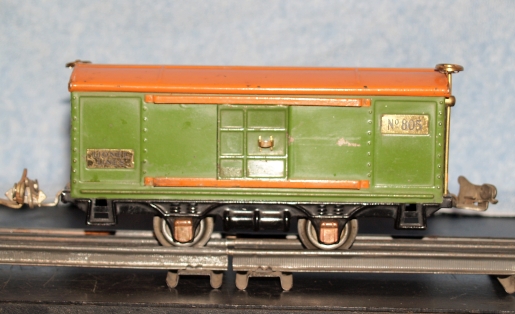
As shown below, I have a Lionel No. 805 Boxcar (manufactured around 1931). This car has a a dark pea-green body with an orange roof. It has copper journal boxes on the wheel axles. The doors on both sides open. The car has brass ladders on each end along with brass brake wheels and column shafts.
No. 805 Boxcar
Shown below, I have a Lionel No. 831 Lumber (Flat) Car (manufactured in 1935). This car is painted pale green with nickel posts, brekewheels and stands, and nickel journal boxes on the wheel axles. Note that I have the original box for this car and most of the original lumber load.
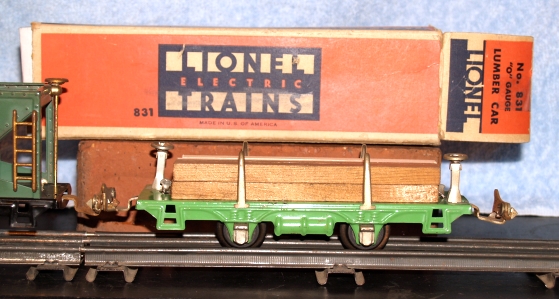
No. 831 Lumber (Flat) Car
Shown below, I have a No. 803 Hopper Car (manufactured from 1931 to 1934). This car is painted peacock and has brass ladders, nameplates, and brake wheels and shafts. The car has copper journal boxes on the wheel axles. The wheel on the lower side open and closes the hatches on the bottom center of the car.
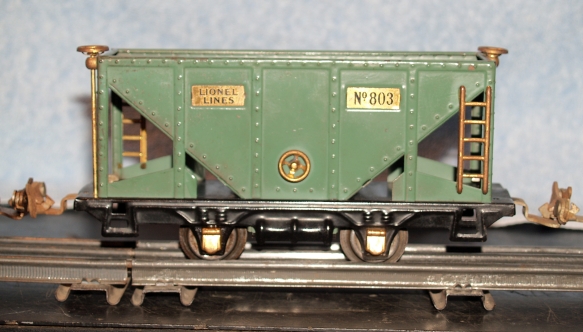
No. 803 Hopper Car
Shown below I have a Lionel No. 807 caboose (manufactured from 1929-1930) The car is painted red with peacock window inserts and roof. The end railing is brass. The caboose has nickel journal boxes over the wheel axles.
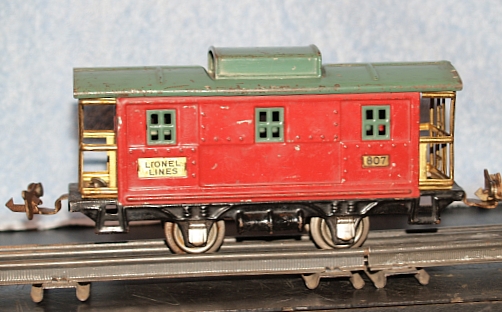
No. 807 Caboose
Shown below I have a Lionel No. 810 derrick car (this example manufactured from 1932-1934) The derrick derrick cab is painted terra cotta with brass window inserts and brass nameplates. The derrick has copper-finished journal boxes over the wheel axles.The three control knobs have a nickel finish. The three control knobs raise/lower the boom, raise the balland hook, and rotate the derrick cab and arm. When I received this car, several teeth on the sector gear that raised and lowered the boom were stripped and the cam that raised the ball/hook was broken and one coupler was missing. Replacement parts are available and I replaced those parts and it works well now. Replacing the sector gear required me to bend tabs on the pieces that hold the boom sides together in order to get the gear between the two sides of the boom. This was a little tricky, but I was able to do it without destroying the car.
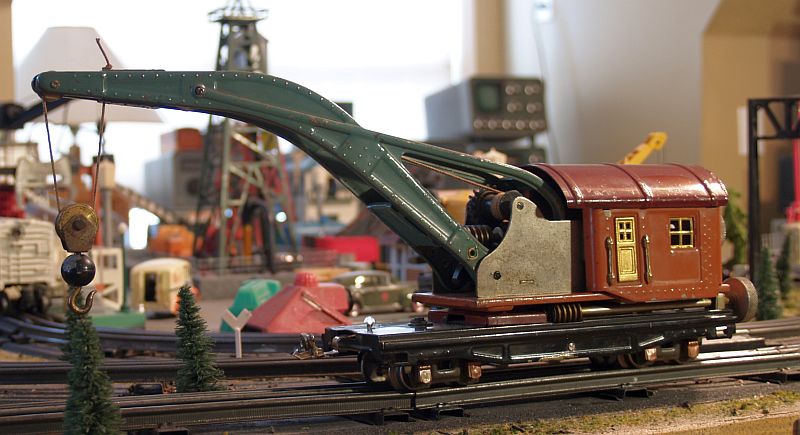
Lionel No. 810 Derrick Car
Shown below is a Lionel No.816 Hopper Car with brass name and number plates and nickel journal boxes. This car was manufactured in 1935.
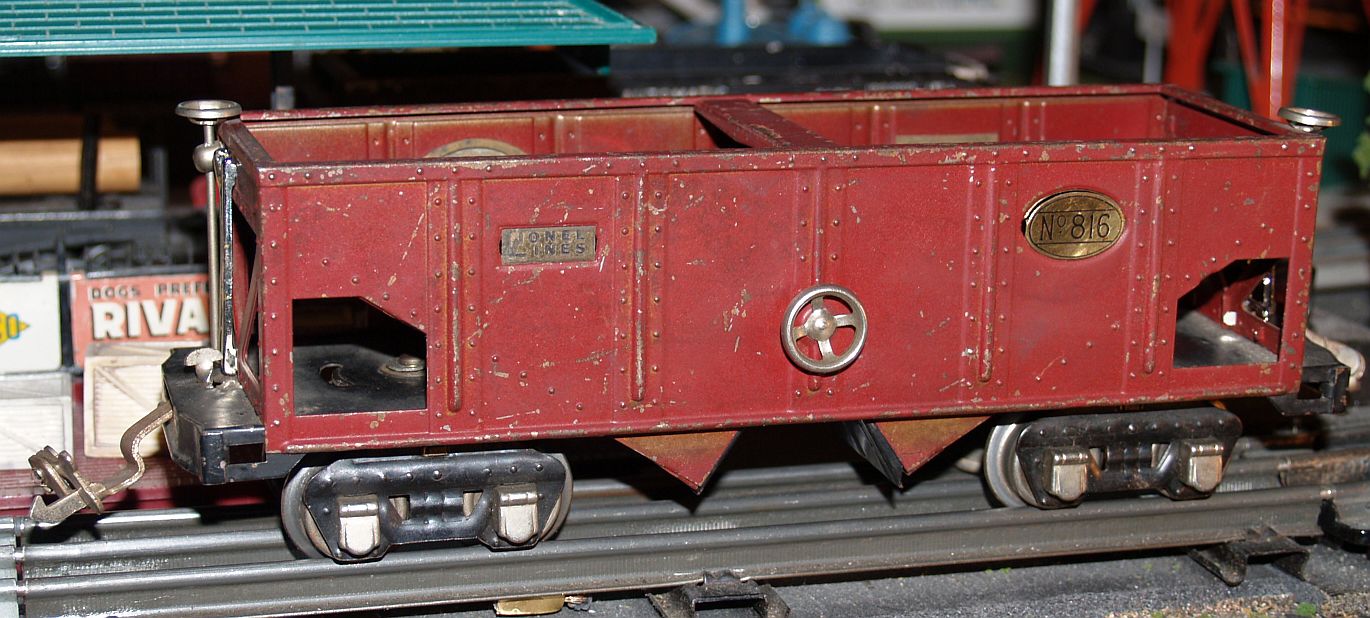
Lionel No. 816 Hopper Car
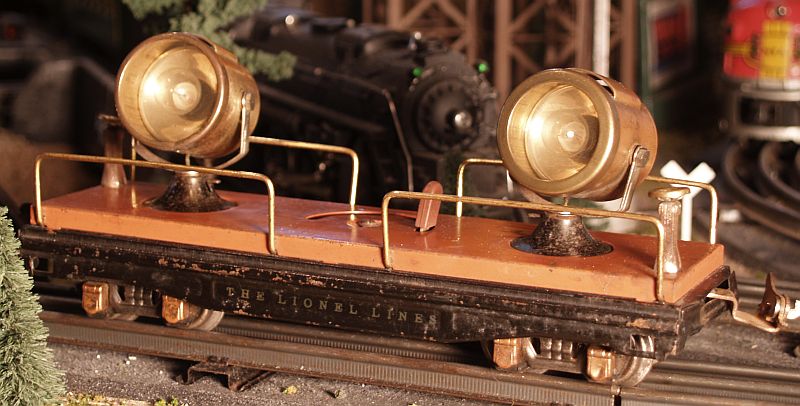
Lionel No. 820 Dual Searchlight Car
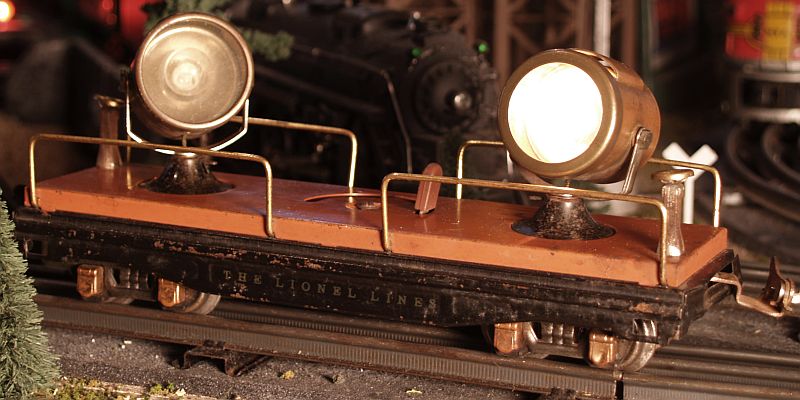
Shown above is a Lionel No. 820 dual searchlight car (manufactured (1931 - 1934). This car has a black body with a subfloor mounted on to to which two searchlights are mounted. The searchlights can be manually pointed in any direction horizontally and in elevation up to about 40 degrees. This production version car has a terrra-cotta subfloor and brass searchlights with glass lenses. The journals on the trucks are copper. Each truck has latch couplers.
In the center of the subfloor is a slide switch that turns the searchlights off, right on, left on, and both on. The pictures below show the three operational modes of the searchlights.
The picture above shows a #3530 Operating Generator Car (manufactured from 1956-1958). The car is a replica of a General Motors Electro Motive Division generator car. It is made of blue plastic with a white stripe painted on its side. Mine has the stripe going through the ladder at the end - other versions have the stripe ending at the ladder. The car has double sliding doors on each side. The left-hand door on the side shown above has a contact switch that when opened, turns on an internal light and starts a vibrator motor driven simulated fan. Inside is also an orange generator that is the same as on the No. 3520 searchlight car I have. Note that I have the original box for this car.The picture below shows the doors open and the light on inside.
The top of the car has ventilation holes through which you can see the light and the simulated fan turning. The picture below shows the top of the car with the interior light shining through.
My generator car has blue fuel tanks below the doors. Other versions have black fuel tanks. The car originally came with a telephone pole/transformer and a searchlight that can be connected to the top of the car and the searchlight illuminates when the door is opened. The telephone pole/transformer and searchlight could also be purchased separately as Lionel # 3530-30. The generator car with the telephone pole/transformer and searchlight connected are shown in the picture below.
The picture below shows the setup with the searchlight illuminated as powered by the generator car.
The picture above shows a Lionel #6362 Railway Truck Car (manufactured 1955-1957). This car has an unpainted orange plastic body mounted on a blued steel chassis. The car has bar-end metal trucks and magnetic couplers. The cargo load for this car are three 479-1 bar end metal trucks.
The picture above shows a Lionel #6511 Pipe Car (manufactured 1953-1956). The car is red with heat-stamped "Lionel 6511" lettering on both sides. The car has bar-end metal trucks with magnetic couplers. Five silver-gray plasic pipes is the load carried by the car. Thirteen spring steel posts hold the pipes in place. This car has heavy die-cast plates on the underside of each end to which the trucks are attached. As such, this car was manufacgtured in 1953.
The picture above shows a Lionel #6464-1 Western Pacific box car (manufactured from 1953-1954). This box car was the first car in the 6464 series of box cars. I understand the 6464-1 Western Pacific is a fairly common car. It was included in sets as well as being available for separate sale. The 6464-1 Western Pacific includes a silver painted shell with blue lettering, type I body style, single block sliding doors, bar-end trucks with two operating couplers, and a single brakewheel. The silver paint on this car tends to fade with age but the silver paint on mine is reasonably bright. The blue lettering on mine in in good shape also.
The picture above shows a Lionel #6464-25 Great Northern Box Car (manufactured from 1953-1954). The body of this car is painted flat orange with white heat-stamped lettering including the Great Northern herald.
The picture above shows two identical Lionel #6464-50 Minneapolis & St. Louis Box Cars (manufactured from 1953-1956). The car has white heat-stamped lettering including the "M & ST. L THE PEORIA GATEWAY" logo. The single tack board doors are painted the same brown color as the body. The car has bar-end trucks with magnetic couplers. Based on the rivet pattern to the left of the door, both of these cars are some of the earliest of these cars produced.
The picture above shows a #6464-75 Rock Island Box Car (manufactured from 1953-1954). The body of this car is painted green with gold heat-stamped lettering. The doors are also painted green. The complete 6464-75 number was not painted on the car - only "6464" was painted on the car.
hr size="4" width="100%">
The picture above shows a Lionel No. 6464-150 Missouri Packfic Eagle box car. The car has bar end trucks and the "Eagle" logo is to the left of the door.
The picture above shows a Lionel #6464-275 State of Maine Box Car (manufactured from 1955-1959). This is a colorful box car with red, white, and blue horizontal stripes. On my car, the body is molded blue plastic and the white and red colors are painted on. My car has bar-end trucks indicating it is of the early production. It also has tab couplers.
The picture above shows a Lionel #6464-375 Central of Georgia Box Car (manufactured from 1956-1957). This car has a maroon-colored body with a silver oval painted on the side. The roof is also painted silver. The lettering outside the oval is heat stamped. The Central of Georgia herald is a decal. My car has bar end trucks, one of which has a tab coupler - the other coupler does not have the tab.
The picture above shows a Lionel No. 6464-400 Baltimore & Ohio Box Car. This example features bar end trucks and has a built date of 5-54 on the side.
The picture above shows a Lionel No. 6468 Baltimore & Ohio Automobile Transport Car (manufactured from 1953-1955). This is a double-door boxcar and actual boxcars of this type were used to transport automobiles before the auto-loader and auto-rack railroad cars became popular. Note that the doors are not in the center of the car (horizontally). My car is in fairly good shape but there are some rust stains to the right of the doors below the upper door rail and on the other side near the bottom. My car is the more common blue car.
The picture above shows a No. X3464 New York Central Box Car (manufactured from 1949-1952) and a No. 6464-425 New Haven Boxcar (manufactured 1956-1958) on a track in front of my No. 256 freight station. The X3464 is an operating boxcar. When the car is over an UCS remote control track section and the "uncouple" button is pressed, the door will slide open and the man inside will move toward the door as shown in the photo. My car is an older version as it has the staple-end trucks. Note that I have the original box and instruction sheet for this car. The New Haven boxcar is highly sought after for its contrasting colors. Mine has the unpainted black body and the "N" has the full Serif type font.
The picture above shows a #3454 Automatic Merchandise Car (manufactured from 1946 - 1947) that I have. This is one of the first operating cars produced after WWII. This 9 1/4-inch long car is painted silver and the PRR logo is blue. The car has opening die-cast doors. This car has cubes of brown plastic "crates" engraved with "Baby Ruth" that are ejected by the remote control track section after the door is first opened by remote control. Repeated remote control action ejects all of the crates, one at a time, and then the last remote control action closes the door. The crates are reloaded via roof hatch.
The picture above shows a #3472 Operating Milk Car (manufactured from 1949 - 1953) that I have. Five milk cans came with the car (the original set had 7 cans). I have the #3462P milk car platform, and the original box for this set. This set is probably Lionel's most popular accessory. This car is a reliable accessory and only occasionally needs cleaning and alignment. I had the platform with my original train set I received from my cousin, but later I purchased the car with the 5 cans and box. The #3472 Operating Milk Car is listed on page 28 of the 1952 catalog as shown below.
After I received the car, I rewired the car to replace the old wiring that was brittle and had cracked insulation. I adjusted and oiled the mechanism and now the car works well. Below are some pictures showing how the car works.
The picture above shows the man inside the car placing a milk can on the platform. Although in this picture you can see through the door and out the door on the opposite side, the car has doors on both sides. I removed the door on the opposite side to manually activate the mechanism for taking this picture. Below are pictures showing the internal mechanism.
Internal Mechanism of No. 3472 Operating Milk Car
As shown above, the mechanism is fairly simple being driven by a single solenoid activated by a special track section that is used to unload my log and coal cars. The special track section also decouples cars. The milk cans are loaded into the car through a door in the top of the car. The cans roll down an inclined trough starting at the top left and ending just to the left of the milk man. You can see the solenoid in the left foreground. When activated, the solenoid plunger moves inward. Below is a picture of the other side of the car.
Internal Mechanism of No. 3472 Operating Milk Car Showing Milk Can to be Captured
The picture above shows the solenoid activated the initial time after loading. At that time, a milk can falls out of the trough and is uprighted ready for the milk man to capture it. You can see the can just to the right of the man and partially obscured by the mechanism. The next time the solenoid is activated, the can is captured by the man as shown below.
In the picture above, you can see the man has the can is ready to move it out of the car. The picture below shows the man placing the can on the platform.
In the picture above, the solenoid is fully activated and the man would be outside the car placing the can on the platform. The milk cans have a tiny magnet on the bottom to hold them on the mechanism. The platform deck is supposed to be steel so the cans will "stick" to it. I lost my original platform deck and I made a replacement from aluminum, but the cans do not "stick" to aluminum and skid significantly on the deck.
I acquired spare milk cans for the milk car. The spare milk can set is shown below in its original box. Lionel sold the #3462-70 milk can set as a replacement item or for use as extra detailing in a train layout. Note the box is lettered "For use with No. 3462 and No. 3472 Milk Cars." This lettering suggests it was manufactured between 1950 and 1957.
No train layout would be complete without a method to deliver the milk once the train transported the milk to its destination. Therefore, I acquired a diecast replication of the once famous 1950 DIVCO (Detroit Industrial Vehicle Company) milk delivery truck. This truck is shown below.
This diecast model is a Lionel Licensed Product manufactured in 2002 by Road Champs. It is a 1:43 scale model. It has written on the side "Lionelville Farms." Beside the truck are three crates containing milk bottles. This model has not ever been removed from its plastic case. The plastic bag surrounding the case is still sealed with the original tape.
The picture above shows a Lionel Lionel No. 3562 AT &SF Barrel Unloading Car. The car contains an internal vibrator motor mechanism that when activated moves the barrels up the sloping metal trough to where the rubber workman "unloads" the barrels.
The picture above shows a Lionel No. 6352 Pacific Fruit Express refrigerator car (manufactured from 1955-1957). This car was originally built to accompany the Lionel No. 352 Icing Station. The car has an unpainted orange body with black heat-stamped lettering. The number on the car is actually 63521. A special sliding roof panel allows the plastic ice cubes to be loaded from the icing station platform. There is a compartment inside to collect the ice cubes and a special door on the side (to the right of the brown door) allows access to the compartment to remove the cubes.
The picture above shows a Lionel No. 6376 circus car (manufactured from 1956-1957). This car is a large bi-level stock car. The body is unpainted white plastic with red markings heat-stamped in red. The roof walk is also painted red. The car has split doors with one for each level on each side. The car has bar-end trucks.
This unpainted car includes a miniature Beachcraft Bonanza airplane with folded wings. This example has metal bar-end trucks and magnetic couplers and is the first version manufactured in 1957. The aircraft is molded in yellow and black plastic. This example has yellow on the upper surfaces and sports a yellow propeller. Note that I have the original box for this car.
As shown below, the bottom of the airplane bears the markings "No. 6800-60 AIRPLANE THE LIONEL CORPORATION NEW YORK, NY. MADE IN U.S. OF AMERICA."
The airplane wings will fold out and lock in place and the landing gear in the wings will support the plane sitting on the ground.
The picture above shows a Lionel No. 6801 Boat Hauling Car (manufactured from 1957 through 1960). This car features an unpainted red flat car carrying a boat in an unpainted gray cradle. An elastic band holds the boat in place. The example is an early version, manufactured in 1957 as it has bar end trucks and the boat is white with a brown deck.
The picture above shows a Lionel No. 3419 Operating Helicopter Car (manufactured from 1959 through 1965). This blue-plastic car has AAR-type trucks with operating couplers. A wind-up mechanism is mounted under the car and a spindle on tpo engages the bottom of the helicopter that mounted to the spindle. The tail of the helicopter is captured in a cradle at the end of the car. The mechanism is manually wound and the helicoper launched manually or via remote-control track section. This example is the later version car with the bright-plated mechanism and the translucent tail on the helicopter. This example has the original box, although not in pristine condition.
The picture above shows a Lionel No. 3474 Western Pacific Operating Box car (manufactured 1952-1953). This box car is the most colorful of the 9 1/4 inch operating box cars. Its body is painted silver and a large Western Pacific yellow-orange feather decal stretches most of the car's length. It also has a smaller decal with the Western Pacific "Rides Like a Feather" slogan in the upper right corner. The box car has an operating mechanism inside on which rides a blue rubber man. When the car is over the decoupling track section and the decouple button is pressed, the plunger on the bottom of the car is activated, the door slides open, and the man moves toward the door as shown in the lower photograph. I do not have the box for this car. My car works well.
The picture above shows a Lionel No. 6672 Refrigerator Car (manufactured from 1954 - 1956). This car has the Santa Fe markings (SFRD) and is a model of a mechancal refrigerator car. The car has no "ice hatches" like other refrigerator ("reefer") cars (such as the No. 3472 car above) because the car is "cooled" by mechanical temperature control (a refrigeration system). The car is longer than older "reefer" cars as this car is 10 1/8 incles long. The sides and floor of the car are molded a a single piece of unpainted white plastic and the roof and ends are molded as a single piece of unpainted brown plastic. The doors on either sides are molded of unapinted brown plastic and when in position over the door opening, a leaf spring in the door guide pushes them down into place. You have to pull the door outward slightly to open the door. Note there is an aluminum refrigeration control panel on the lower left. When you slide the panel to the left, controls are revealed and the manufacturer name Carrier is revealed. The picture below shows the panel opened.
The car has bar end metal trucks with tab couplers. My car is in good shape; however, there is some rust on the door guides. Note that I have the original box for this car. The box is in good shape with 397 marked on it. I presume that marking indicated the sale price; however, in the 1954 Lionel catalog, the factory recommended price for this car was $5.95. My car is the later version as there are 2 lines of data to the right of the door.
The picture above is a Lionel No. 6346 Alcoa Aluminum hopper car (manufactured 1956 only). This is one of the few covered hopper cars manufactured by Lionel. This car has a silver painted body, blue lettering, bar end trucks, one brakewheel, and a stick-on Alcoa Aluminum emblem on both sides. The actual number painted on the side is "643656." The car is long measuring 10 3/4 inches, not including the couplers on each end.
The cover has 12 hatches; however, mine has 2 hatches missing as the hatches are fragile and the hinges easily broken. Replacements can be obtained for the missing hatches. Note that I have the original box for this car. One of box end flaps is detached, but present, and the other is missing.
The picture above shows a Baby Ruth Scout-type boxcar (manufactured 1951-1956). The doors on this inexpensive boxcar do not open and the brakewheel is molded into the plastic.
Below are pictures of the passenger cars that I have.
The picture above shows a Lionel No. 2400 passenger car (manufactured from 1948-1949). This car is one of three similar attractive passenger cars in the 2400 series. These plastic streamlined cars had bodies painted green with yellow stripes and yellow window outlines. The lettering on this Pullman was heat-stamped in white and the roof was dark gray. This car is illuminated with plain frosted window inserts. Maplewood is a town in New Jersey near the former Lionel manufacturing plant.
The picture above shows a Lionel No. 2401 passenger car (manufactured from 1948-1949). This car is the observation car offered to accompany the 2400 and 2402 passenger cars. Its paint and markings is the same as the 2400 and 2402 cars. Hillside, New Jersey was the home of the Lionel manufacturing plant when this car was manufactured.
The picture above shows a Lionel No. 2402 passenger car (manufactured from 1948-1949). The second Pullman car offered in 1948-1949 was the 2402 Chatham car. Its paint and markings is the same as the 2400 and 2401 cars. Chatham is a community in New Jersey near the former Lionel manufacturing plant.
Below is a picture showing all three passenger cars in a train and illuminated.
Below are pictures of the motorized units that I have.
The picture above shows a Lionel No. 41 Switcher (manufactured from 1955-1958) that I have. This unit is modeled after the experimental gas turbine switching engine built by the Davenport Locomotive works for the US Army Transportation Corps. The prototype switcher is powered by two Boeing gas turbines. The top speed of the Davenport locomotive is only 35 mph and Lionel designed its version to also be considerably slower than their other road locomotives. The actual twin Boeing turbine-powered locomotive is preserved at the National Museum of Transportation in St. Louis, MO.
Both the real and Lionel versions are intended for light yard work and should not be expected to pull no more than 3-4 freight cars.
The Lionel No. 41 has a ornamental horn, three position E-unit, and operating couplers on the front and rear. My unit is made of black plastic. Note that I have the the original box and the attendant operating instructions. On the box, the price is written as $11.50. It is worth considerably more than that now. My unit works well both forward and reverse. All wondow struts are present; however two on one side are cracked. These struts are easily broken with your thumb when picking up the engine.
The picture above shows a Lionel No. 51 Switcher (manufactured from 1956-1957) that I have. This 2-4-2 unit is a replica of a 30-ton switcher built by the Vulcan Iron works of Wilkes-Bare, PA. The unit has white heat-stamped lettering applied to an unpainted blue plastic body. The body has blued-steel handrails and an ornamintal horn. It also has a three-position E-unit. The window struts are often missing on these units. Mine has both window struts, but both are cracked.
The picture above shows a Lionel No. 53 Rio Grande snow plow (manufacured 1957-1960) I have. This motorized unit unit is based on the Vulcan 2-4-2 switcher. The cab is painted yellow and the remainder is unpainted black plastic. There is an unpainted yellow snowplow blade on the front and an operating coupler on the rear. It has an E-unit internal that changes direction with power interruptions similar to my Santa Fe locomotive. Notice the window strut is broken but all of it is still there. The one on the other side is also broken. This is a common problem with these units as the struts are thin and is in the perfect place for your thumb to press it in when you pick the unit up.
The picture above shows a Lionel No. 58 Great Northern rotary snow plow (manufacured 1959-1961) I have. This motorized unit unit is based on the Vulcan 2-4-2 switcher, but it is heavily modified to include a rotary snow blower on the front. The blower actually turns as the unit moves down the track. It has an internal E-unit that changes direction with power interruptions. It has a operating coupler on the rear so the unit can pull small loads. The body is unpainted green plastic with white cab sides and heat-stamped lettering.
The picture above shows a Lionel No. 60 trolley (manufactured from 1955-1958). This unit is based on the Birney design and has a reversing mechanism similar to the No. 50 gang car. It has an unpainted yellow body and an unpainted red roof. The lettering was applied with heat-stamping. The lettering on this unit is black indicating it is a unit produced early in the production. This unit does not have the motormen that were included in the very first units.
The unit has a trolley pole on the top (that in a real trolley collected power from an overhead wire). The pole swings around in the opposite direction when the trolley strikes an obstruction. This unit has the two part spring-type bumpers on the front and rear that make the car reverse when it strikes an obstruction.
The inside of the car is illuminated and there are silhouettes of passengers printed on the frosted windows.
When I received this item, I had to perform some repairs: resolder the 2 field coils wires, replace the motor ball bearing, repair one motor brush, take the car apart and oil and regrease it, replace the interior lamp, clean the entire car. The result of this work produced a gool-looking car that runs very well.
Click on the picture below and you can see a short movie of the car in action. The continuous "buzz" you hear is the vibrotor of the No. 155 Ringing Signal next to the train station. The bell of the ringing signal is difficult to hear in this video.
I also have a Lionel No. 60 trolley with blue lettering with its original box as shown below.
This unit is identical to the Lionel No. 60 Trolley with black lettering shown above except the lettering is blue. This blue lettering trolley also has the two-part spring bumpers. When I received this unit, I had to perform some minor repairs: repair the tabs inside the car that held one end of the roof in place, clean and grease the motor armature, and re-attach the metal pinion gear to the trolley pole shaft. Apparently, when someone tried to remove the trolley pole, it was stuck to the shaft and pulling hard, pulled the pinion gear off the shaft. Fortunately, the pinion gear remained in the car.
Note the price for the trolley as seen on the tag on the box was $8.50.
Below is a picture of both trolleys.
The picture above is a Lionel No. 68 Executive Inspection Car (manufactured 1958 - 1961). This motorized unit resembled a 1958 DeSoto station wagon equipped with a Hy-Rail device allowing it to operate on railways. The unit has a 2-position E-unit that is turned off an on by a switch, the knob of which is vaguely disguied as a warning beacon on top of the car. The E-unit does not have a center neutral. The car goes either forward or backward as the track power is cycled off and on.
The picture above is a Lionel No. 69 Maintenance Car (manufactured 1960 - 1962). The design of this car is based on the Lionel No. 50 Gang Car. The motor brushplate was molded in dark gray plastic. The modified gand car body was unpainted black plastic wih white heat stamped markings. A light gray plastic platform was mounted above the body. On one end of the platform was a red plastic sign with "Safety First" on one side and "Danger" on the other side. The sign rotates when the car reverses direction after the bumpers hit an obstruction. A rubber man was stationed on the other end of the platform.
The picture above shows a Lioenl No. 3360 crane (manufactured from 1956-1957). This self-propelled crane is a replica of the small crane manufactured by Cullen-Friestedt of Chicago for railroads. The body of the Lionel crane is molded in yellow and has red heat-stamped lettering. The crane can go backwards and forward with the direction controlled by a lever on the side shown that could be moved by a track-side activator. A lever on the opposite top side controls whether the crane moves or the cab rotates - the direction depending on the position of the lever on the side. That lever can also place the crane in "neutral" (middle position) so it does not move. The lever on the back of the cab disables cab rotation and allows the operator to raise and lower the block and tackle - the direction up or down depending on the position of the lever on the side. The crane has a non-operating coupler on each end to allow it to pull light loads. I have the original box with the insert for this crane. Note the price when purchased new is on the box and the price was $15.95.
The picture above shows a two-person handcar (Model 2002) manufactured by Louis Marx & CO, Inc. The car was the second version of this model and was manufactured from 1955 to 1956. This car is electrically powered and controlled with the transformer like a locomotive. For a long time the two railroad workers on each end of the arm were missing. I found a source of repair parts and replaced them as shown above. The car supposed to have one blue and one gray man. As the car goes down the track, the men appear to pump the arm up and down.
I understand this red version is relatively hard to find. The previous version was also red but the two men were yellow. The subsequent version was brown with blue and gray men. My car does have some damage - there are two short bumpers broken off one end and part of the top of the car is also broken on one side. One of the handles for one of men is also broken. These defects do not significantly detract from the car.
I also have acquired the brown version. Below are pictures of the brown version with the blue and gray men and the original box.
The picture above shows a Lionel No. 50 Gang Car (manufactured from 1954-1964). This was the first of the series of motorized units that Lionel manufactured. This car is self-propelled and has 3 men, two blue and one olive-colored. The car has an unpainted orange body and brushplate and an ornamental horn. The car has two blue rubber bumpers on either end and when one of the bumpers strikes an obstruction, the car reverses direction and the olive-colored man rotates to the other side of the car. This car was relatively inexpensive and is small.
I believe my car was manufactured between 1955 and 1959 because the bumper bracket is U-shaped. Later versions were L-shaped. Note that I have the original box with the operating instructions. The box also contains the carboard insert. This car runs very well.
The No. 50 Section Gang Car as shown on page 8 of the 1959 Lionel Consumer Catalog is shown below. Note the price was only $7.95.
The picture above shows a Lionel No. 54 Ballast Tamper (manufactured from 1958-1961). This unit moves only in the forward direction. On the front of the unit is the gray housing for the tamper bars. Activation of the tampers is controlled by a railside trip that when the unit passes by, it slows down by about 50% and the tampers alternately go up and down until it passes by another railside trip and then the tampers stop, and the unit resumes nornal speed.
The picture above shows a Lionel No. 55 Tie Jector Car (manufactured from 1957-1961). The unit carries wooden crossties and when it passes by a trackside trip, it dispenses the crossties at intervals along the trackside until it passes by another trackside trip at which time the dispensing stops.
Lionel No. 260E Tinplate Steam Locomotive (1930s)
The picture above shows Lionel's 260E locomoive and 260T tender. This locomotive was introduced in 1930 and at that time was Lionel's top of the line locomotive. This example is the early version built in 1930 with the cream stripe painted on the side of the running board. The running board is part of the die cast frame. This example has a pendulum-type two-position E-unit and when cycled by track power, it changes from forward to reverse. There is no neutral positon in the E unit. The example above does not have the "chugger" mechanism as was included in later units, but it does have an operational white headlight and a red light beneath the cab to simulate the hot firebox.
The 8-wheel tender above is not the tender that originally came with the locomotive. The original tender has a cream stripe along the side and a black base. The tender above does not have the stripe and the base is green. Otherwise, the tenders are the same.
When I received the engine, it needed some work but it did run. The rear trailer truck was missing and the cotter pin and cotter pin post were missing from the locomotive frame. Both crank rods and screws to hold them on were missing. One of the two fiber intermediate gears and pinion had missing teeth. And the wires and washers for the two lamps were missing as well as the lamps. The lens for the headlight was also missing. I was able to purchase replacement parts for all of them and now the locomotive runs quite well. The picture below shows the underside of the engine. You can see the cotter pin post I made at the left in the picture. Instead of a cotter pin, I used a screw and a nut to hold the truck in place.
Lionel No. 262 Tinplate Steam Locomotive (1930s)
The picture above shows Lionel's 262 locomoive and 262T tender.This locomotive has a 2-4-2 wheel configuration and was manufactured from 1931 to 1932 and at that time was Lionel's "mid-level" locomotive. Also shown is the attendant 262T tender. This unit does not have an electronic reversing unit. Instead, there is a lever inside the cab where one can manually switch direction from forward to reverse. Up is forward and down is reverse. Once can place the lever midway between and the locomotive is in "neutral."
The locomotive has copper and brass trim. When I received the locomotive, the front sand dome and ornamental bell were missing. In addition, the screws on both sides that form "hinges" for the boiler front to open for lamp bulb replacement were missing. But the locomotive did run and the lamp was good. I acquired a brass sand dome and painted it copper. I also acquired a copper ornamental bell for replacement. And I acquired two screws for the boiler front. After replacing some internal wiring, the insulation of which has rotted, cleaning the motor commutator and brushes, and adjusting the collector to press harder on the center track rail, the locomotive runs as good a new. I also washed the locomotive with mild soap and water and used car wax to clean it up. It looks almost as good a new considering its age.
Below are some other pictures of the locomotive; one picture shows the headlight on.
Lionel No. 258 Tinplate Steam Locomotive (1930s)
The picture above shows a Lionel tinplate steam engine and associated tender. This engine and tender were manufactured in 1930 shortly after Lionel acquired sole ownership of Ives Manufacuring Company. The 258 is identical to the Lionel 257 engine except the 258 has a manual reverse lever. The 258 engine is interesting as it has brass and copper trim with orange-red stripes painted on. This example has the origial paint as it is somewhat pitted and scratched off in several places. But the engine runs well. I believe the 4 drive wheels are replacement because the red-painted spokes are not dull. But the front pilot wheels are original, I believe. Below is a picture of the engine with power applied to the track and the headlight on.
Below is a picture of the side of the engine.
Below is a picture of the bottom of the engine. Note both power pickup rollers are original and in tact. Often, one of the rollers are broken or the roller assembly has been replaced. This example has the original roller assembly with the Lionel name.
The tender is also in good shape. The paint on it is also pitted. The tender is missing the brass handrail on the top rear, but it has the brass ladder on the rear. Below is a picture of the tender. The tender has the coal pile that is often missing.
The picture below is a picture of the engine and tender seen from the rear. The lever in the engine cab is the manual direction control. This engine does not have the "E-unit" used to remotely change direction of the train. When the lever is placed in the center position (level) the train is in "neutral".
Below is a picture of the 258 engine and 257T tender pulling four cars.
As shown below, I have a Lionel No. 805 Boxcar (manufactured around 1931). This car has a a dark pea-green body with an orange roof. It has copper journal boxes on the wheel axles. The doors on both sides open. The car has brass ladders on each end along with brass brake wheels and column shafts.
Shown below, I have a Lionel No. 831 Lumber (Flat) Car (manufactured in 1935). This car is painted pale green with nickel posts, brekewheels and stands, and nickel journal boxes on the wheel axles. Note that I have the original box for this car and most of the original lumber load.
Shown below, I have a No. 803 Hopper Car (manufactured from 1931 to 1934). This car is painted peacock and has brass ladders, nameplates, and brake wheels and shafts. The car has copper journal boxes on the wheel axles. The wheel on the lower side open and closes the hatches on the bottom center of the car.
Shown below I have a Lionel No. 807 caboose (manufactured from 1929-1930) The car is painted red with peacock window inserts and roof. The end railing is brass. The caboose has nickel journal boxes over the wheel axles.
Shown below I have a Lionel No. 810 derrick car (this example manufactured from 1932-1934) The derrick derrick cab is painted terra cotta with brass window inserts and brass nameplates. The derrick has copper-finished journal boxes over the wheel axles.The three control knobs have a nickel finish. The three control knobs raise/lower the boom, raise the balland hook, and rotate the derrick cab and arm. When I received this car, several teeth on the sector gear that raised and lowered the boom were stripped and the cam that raised the ball/hook was broken and one coupler was missing. Replacement parts are available and I replaced those parts and it works well now. Replacing the sector gear required me to bend tabs on the pieces that hold the boom sides together in order to get the gear between the two sides of the boom. This was a little tricky, but I was able to do it without destroying the car.
Shown below is a Lionel No.816 Hopper Car with brass name and number plates and nickel journal boxes. This car was manufactured in 1935.
Shown above is a Lionel No. 820 dual searchlight car (manufactured (1931 - 1934). This car has a black body with a subfloor mounted on to to which two searchlights are mounted. The searchlights can be manually pointed in any direction horizontally and in elevation up to about 40 degrees. This production version car has a terrra-cotta subfloor and brass searchlights with glass lenses. The journals on the trucks are copper. Each truck has latch couplers.
In the center of the subfloor is a slide switch that turns the searchlights off, right on, left on, and both on. The pictures below show the three operational modes of the searchlights.